Guide
Candidate rejection email: 5 templates that keep good people warm
Candidate rejection email templates for every hiring stage, plus timing, how to give feedback and GDPR rules for keeping CVs. Copy, adapt, send.
A candidate blocks out half a day, prepares for your interview, then waits for weeks. In a Czech simulation by Workify, 58% of CVs sent to employers got no reply even after 30 days. A good rejection email takes two minutes to write and can turn a disappointed applicant into an advocate.
Key points
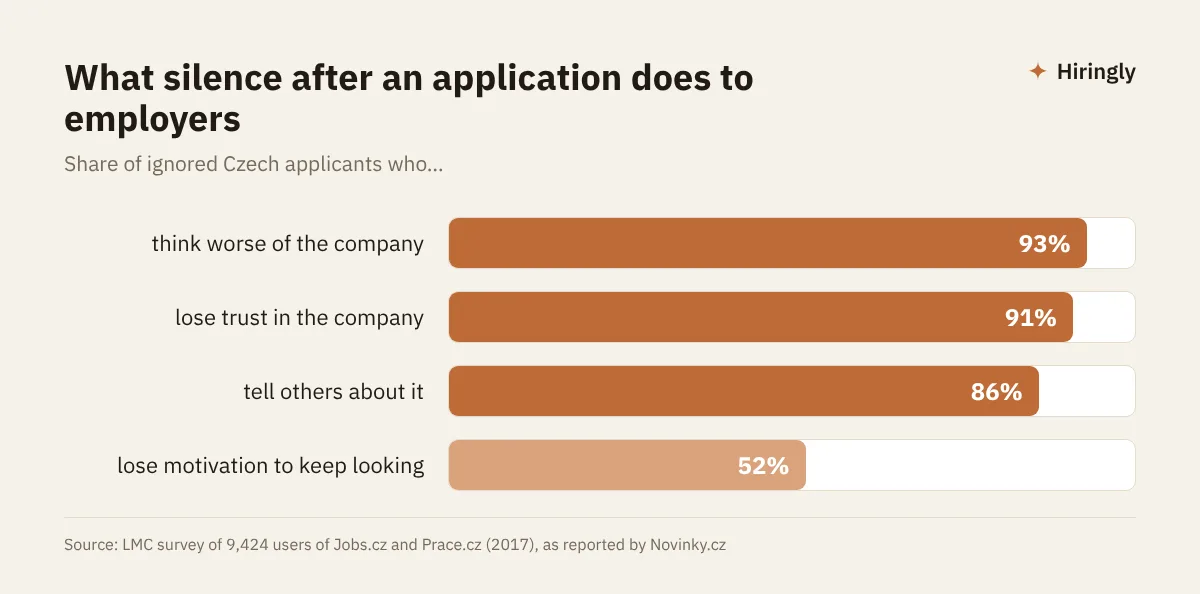
- Silence costs you: 93% of ignored applicants think worse of the company and 86% tell other people.
- 79% of candidates would reapply to a company that gave them feedback after an interview.
- The further a candidate got, the more personal the rejection should be, from a short email to a phone call.
- Keep a rejected candidate's CV only with consent and for a fixed period.
- Below are 5 ready-to-use rejection email templates.
Why rejection matters more than most employers think
A rejection is not admin. It is the last impression a person takes away from your company.
And that impression travels. In an LMC survey of 9,424 users of the Czech job boards Jobs.cz and Prace.cz, 93% of ignored applicants said they think worse of the company and 91% lose trust in it. According to the same source, employers known for replying get up to 20% more responses to their job ads.
Ghosting after interviews is still common
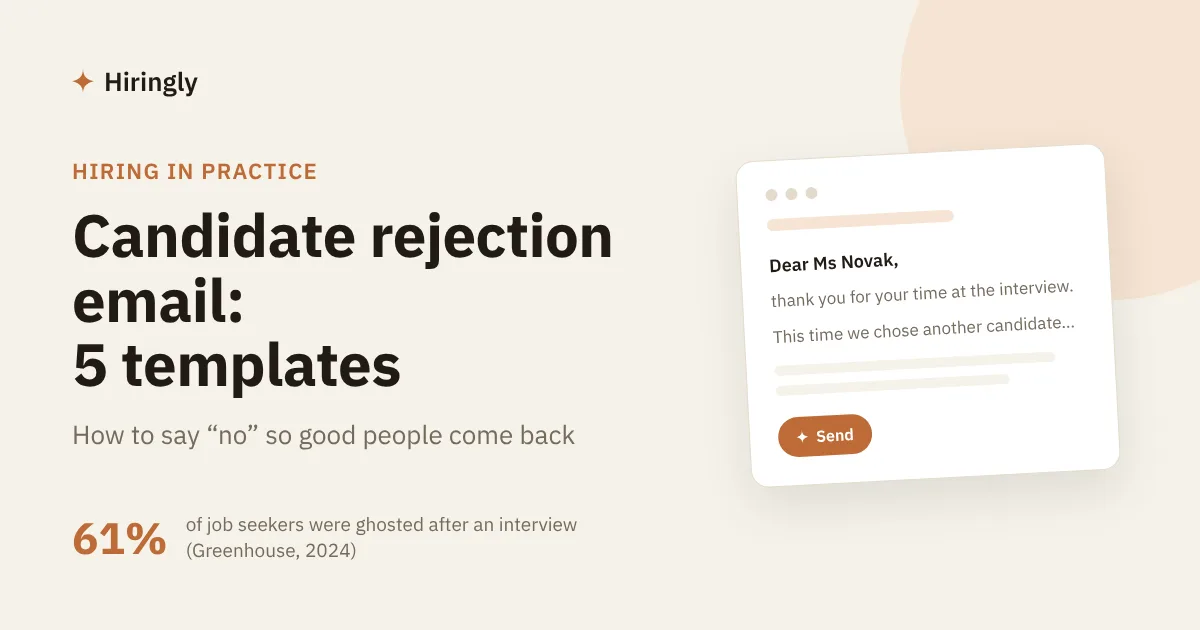
It is not only unanswered CVs. In a Greenhouse survey of 2,500 workers in the US, UK and Germany, 61% of job seekers said they had been ghosted after a job interview.
That is the most expensive mistake of all. The candidate invested time, your managers invested time, and the relationship ends in silence.
A good rejection pays you back
The upside is real. According to the Greenhouse Candidate Experience Report 2024, 79% of candidates would reapply to a company that gave them feedback after an interview, even without an offer.
LinkedIn reports that 94% of candidates want feedback after an interview, and those who get constructive feedback are four times more likely to consider a future opportunity with the company.
When and how to reject a candidate
The rule is simple: match the effort of your rejection to the effort the candidate put in.
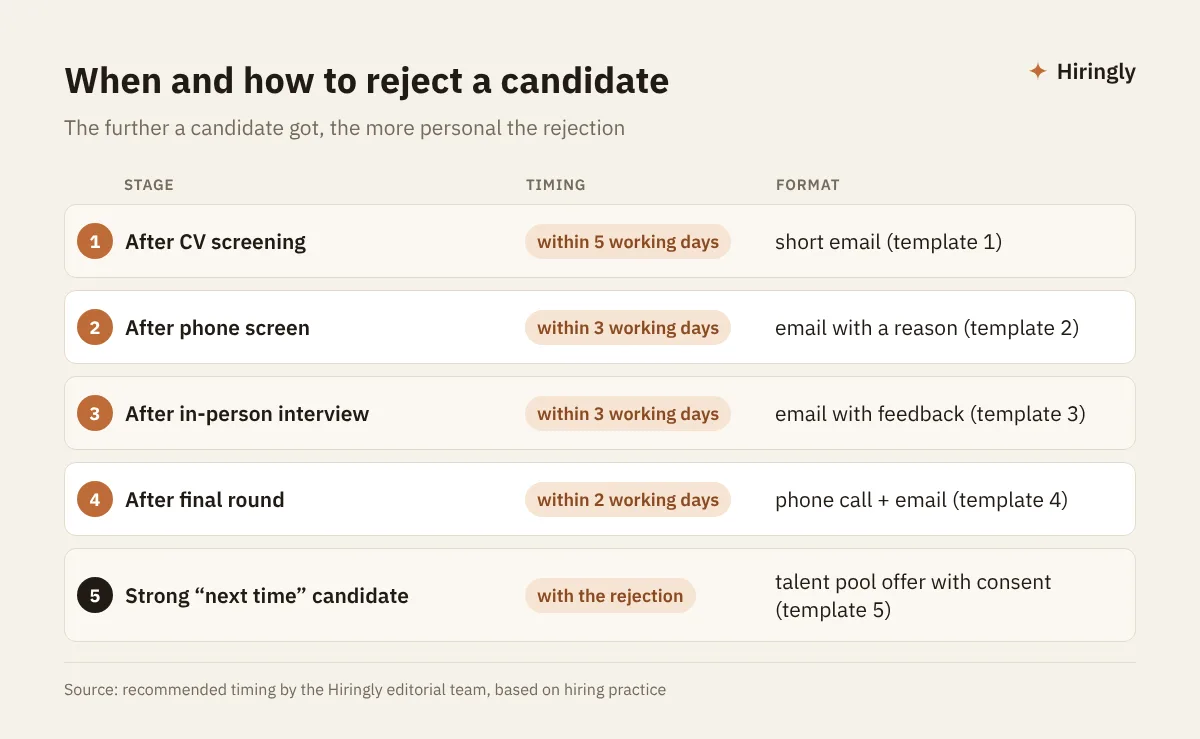
- After CV screening: a short, polite email is enough. It can be sent in bulk, but use the person's name.
- After a phone screen: an email with one sentence on why it did not work out this time.
- After an in-person interview: an email with specific feedback on one or two points.
- After the final round: pick up the phone. Someone who spent hours with your team deserves to hear it from a person.
If you have dozens of applications and do not know who to answer first, rank them before you reply. Our guide to AI candidate screening shows how to do that quickly.
5 candidate rejection email templates
Keep them short and human. Replace the brackets with real details.
Template 1: after CV screening
Hi [First name],
Thank you for applying for the [Role] position and for sending us your CV.
After careful review, we have decided to move forward with candidates whose experience more closely matches what we need right now. We wish you the best of luck with your search.
Kind regards, [Name], [Company]
Template 2: after a phone screen
Hi [First name],
Thanks for the conversation earlier this week. We have decided not to move forward this time, because for this role we need someone with deeper hands-on experience in [area].
If we open a role closer to your profile, I would be glad to reach out.
Best, [Name]
Template 3: after an interview, with feedback
Hi [First name],
Thank you again for the time you spent with us. We have decided to go with another candidate.
What stood out in your interview was [specific strength]. The deciding factor was [specific reason, for example the other candidate's longer experience leading a team].
If it helps, I am happy to share more detailed feedback over a short call.
Best regards, [Name]
Template 4: after the final round (following a call)
Hi [First name],
As I mentioned on the phone today, we have offered the role to another candidate. It was a close call, and your case study was one of the strongest we saw.
We really appreciate the time and effort you put into the process.
Warm regards, [Name]
Template 5: a strong candidate for next time
Hi [First name],
We have chosen another candidate for the [Role] position this time. Your profile impressed us, though, and we would like to contact you when a suitable opening comes up.
May we keep your CV on file for [12 months]? Just reply "yes". You can withdraw your consent at any time.
Kind regards, [Name]
| Template | When to use | Length | Personal touch |
|---|---|---|---|
| 1 | after CV screening | 3 sentences | first name |
| 2 | after a phone screen | 3 to 4 sentences | one reason |
| 3 | after an interview | 5 to 6 sentences | strength + reason |
| 4 | after the final round | call + email | credit for real work |
| 5 | talent pool | 4 sentences | consent request |
GDPR: what to do with a rejected candidate's CV
During the hiring process you do not need the candidate's consent. Processing is needed to take steps toward a contract, as a Czech legal commentary on epravo.cz explains.
Once the process ends, things change. According to the same source, the employer should destroy copies of documents with the applicant's personal data unless it has explicit consent to keep them.
- No consent: delete the CV, both digital and paper copies, once the process closes.
- With consent: set a fixed period, for example 12 months, and stick to it.
- Transparency: tell applicants when you receive their CV what you will use it for and for how long.
Note: legal experts disagree on whether a CV can be kept after the process on the basis of legitimate interest. Právní prostor calls consent the safest option, which is why Template 5 asks for it directly.
For the full list of obligations, see our GDPR and EU AI Act checklist for recruiting.
Checklist: rejecting a candidate step by step
- 1Reply to everyone who applied, even with one sentence.
- 2Stick to the timing for each stage (see the infographic above).
- 3Use the candidate's name and mention the role.
- 4After an interview, give one specific reason and one strength.
- 5Avoid reasons that could look discriminatory (age, family, health, origin).
- 6Offer strong candidates a place in your talent pool and ask for consent.
- 7Delete CVs you no longer need as soon as the process ends.
- 8Once a quarter, check that no applicant was left without an answer.
The most common reason for silence is lack of time. A system that ranks applicants and reminds you who still needs an answer helps. Hiringly is a free AI ATS: it ranks applicants by fit and explains why for each one, so writing a rejection with a concrete reason takes less time. A human always makes the decision, and data stays in the EU. For more ways to speed things up, read how to reduce time to hire.
Looking for a job yourself? Browse current openings on the Hiringly job board.
FAQ
Do employers have to reply to every applicant?
In the Czech Republic, the law does not explicitly require a reply to every applicant. But silence clearly hurts reputation and future application numbers, as the LMC data above shows.
Should I give a reason in a rejection email?
After CV screening, a general line is fine. After an interview, one specific and factual reason helps. Avoid anything related to age, gender, family, health or origin.
How quickly should I reject a candidate?
Ideally within 5 working days after CV screening and within 2 to 3 working days after an interview. The longer you wait, the more likely the candidate accepts another offer and remembers you badly.
Email or phone?
Email is fine up to the first interview. After the final round, call first and confirm with a short email.
Can I keep a rejected candidate's CV?
Only with their consent and for a defined retention period. Without consent, delete the CV once the hiring process ends.
AI recommends, a human decides.
Hiringly shows the reasoning for every candidate, stores data in the EU and never rejects anyone automatically.