Guide
Probation period in Czech Republic: 4 months and 9 rules for 2026
Probation period in the Czech Republic after the 2025 amendment: up to 4 months, 8 for managers. How it extends, how to end it and 9 rules for employers.
A probation period is the cheapest insurance an employer gets when hiring. Since the 2025 "flexi amendment" to the Czech Labour Code, it can run a third longer, can be extended after signing and is counted differently. If your contract template still says "3 months", you are leaving flexibility on the table, or inviting a dispute.
Key points
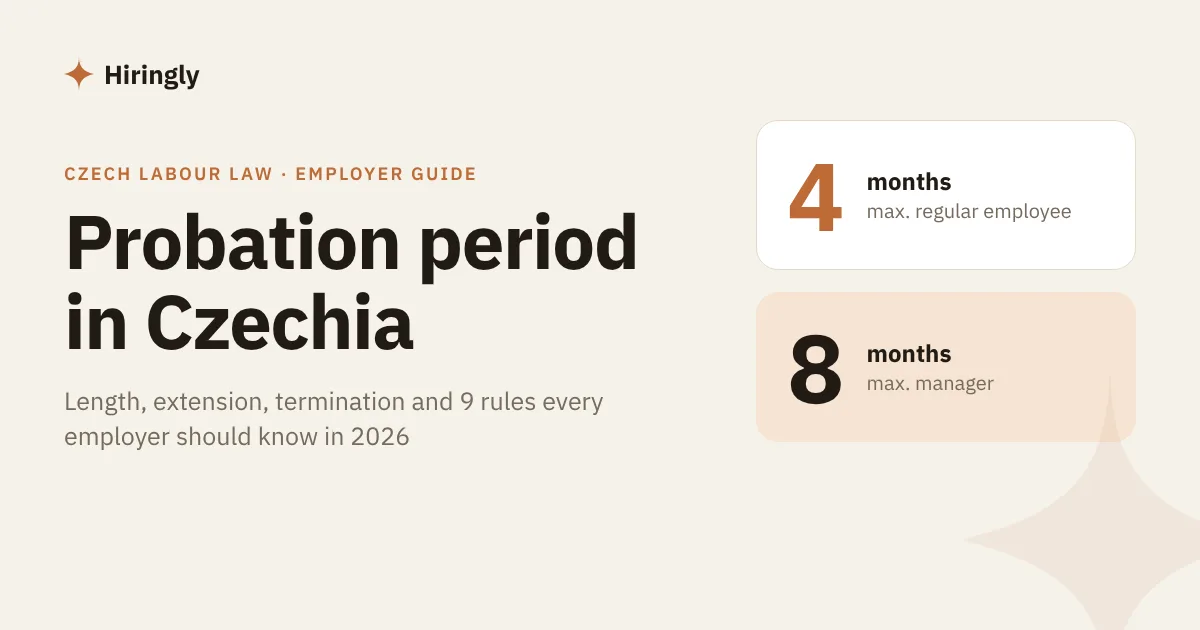
- Probation can last up to 4 months for regular employees and up to 8 months for managers.
- It can now be extended by written agreement, but only up to the legal maximum and only while it is still running.
- It extends automatically by every fully missed shift: sick leave, holiday and unexcused absence.
- Either side can end employment during probation for any reason, always in writing. Employers cannot do so in the first 14 days of sick leave.
- The new rules apply to probation periods agreed on or after 1 June 2025.
What changed in the Czech probation rules
The flexi amendment (Act No. 120/2025 Coll.) took effect on 1 June 2025. According to the Czech Ministry of Labour (MPSV), it brought three big changes for probation periods agreed from that date:
- A longer maximum. 4 months instead of 3 for regular staff, 8 instead of 6 for managers.
- Extension by agreement. Previously, changing the length later was not allowed.
- A new way to count extensions. What matters is the number of working days on which the employee did not work a full shift.
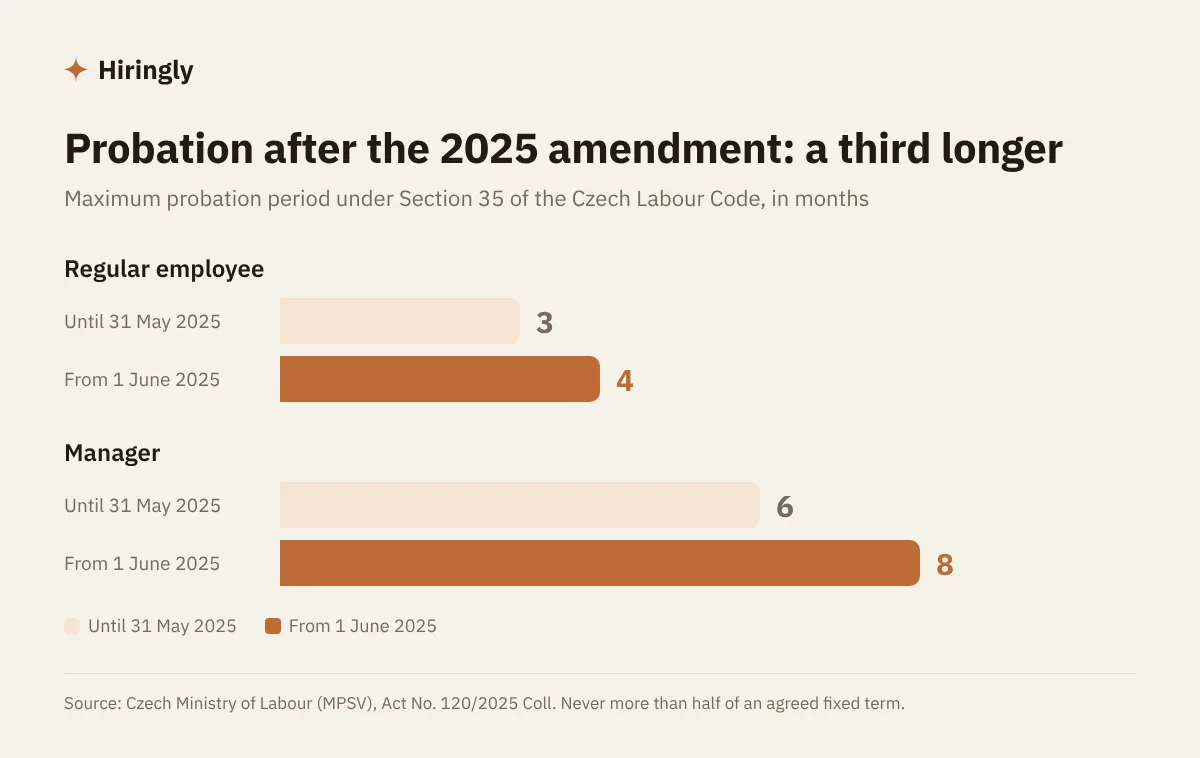
Who counts as a manager
Under Section 11 of the Labour Code, a manager is anyone with at least one direct report. A shift supervisor with one person under them qualifies, as Czech legal portal Právní prostor points out.
The half-of-fixed-term cap
On a fixed-term contract, probation can never exceed half of the agreed term. A manager on a one-year contract gets 6 months at most, not 8. This is the rule employers forget most often.
| Contract type | Regular employee | Manager |
|---|---|---|
| Indefinite | up to 4 months | up to 8 months |
| Fixed term, 12 months | up to 4 months | up to 6 months |
| Fixed term, 6 months | up to 3 months | up to 3 months |
| Fixed term, 3 months | up to 1.5 months | up to 1.5 months |
How a probation period gets extended
There are two routes: automatically by law, or by agreement between both sides.
Automatic extension
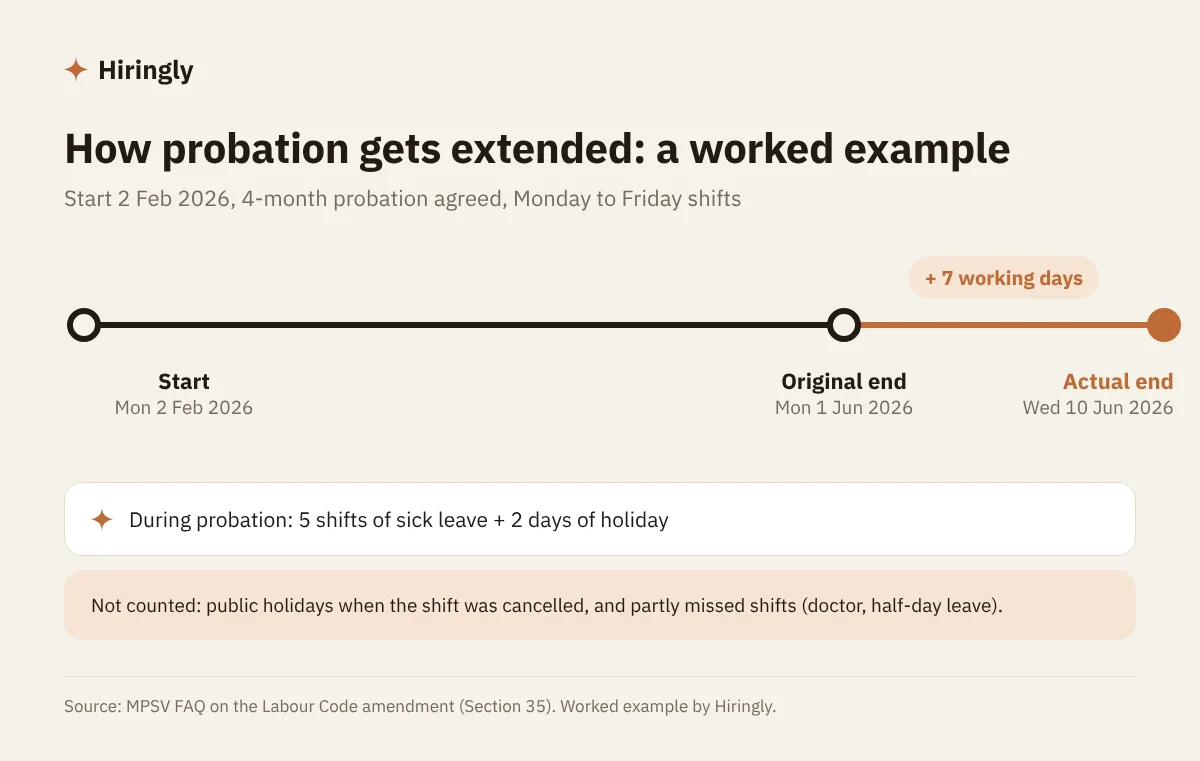
Probation is extended by the working days on which the employee did not work a full shift because of:
- an obstacle to work (typically sick leave),
- taking holiday,
- unexcused absence (new since the amendment).
Public holidays when the shift was cancelled do not count, and neither do partly missed shifts such as a doctor's visit or a half day off. The extension is counted in working days after the original end date, not in calendar days, MPSV explains.
Extension by agreement
This is the option employers like most, but the conditions are strict:
- the agreement must be in writing,
- it can only be signed while probation is still running,
- the total cannot exceed 4 or 8 months,
- if you already agreed the maximum, there is nothing left to extend.
A practical approach: agree 3 months and keep one in reserve. If you are still unsure after three months, you can propose an extension. The employee does not have to accept, though.
Note: extension by agreement does not work for probation periods agreed before 1 June 2025. The date the contract was signed is what counts, not the start date.
Ending employment during probation
The amendment left this part untouched. According to the MPSV handbook on Section 66:
- Both employer and employee can end the employment at any time during probation.
- No reason is needed. It can be for any reason or none at all.
- It must be in writing. An oral termination has no effect and employment continues.
- Employment ends on the day the notice is delivered, unless it states a later date.
- The employer cannot terminate in the first 14 calendar days of the employee's sick leave.
When giving a reason backfires
You do not have to give a reason, and often it is wiser not to. If you do, it must not be discriminatory. Citing pregnancy, age or health is a fast track to court or a labour inspection.
9 probation rules: a checklist for employers
Probation is also a test of you as an employer. Gallup found that only 12% of U.S. employees say their company does a good job of onboarding, while people with an exceptional start are 2.6 times as likely to be extremely satisfied with their workplace. Here is how to get the most out of probation.
- 1Agree it in writing no later than the start date. For managers, before their appointment. You cannot add it afterwards.
- 2Update your contract template. If it still says "3 months, 6 for managers", you are not using the new limits.
- 3Watch the half-of-fixed-term cap. It is the most common mistake on short contracts.
- 4Leave room for an extension. Agree slightly less than the maximum.
- 5Track fully missed shifts. Sick leave, holiday and unexcused absence move the end date. Without records, you do not know when probation really ends.
- 6Set milestones. A short check-in at 30, 60 and 90 days. Our 90-day onboarding checklist has a ready-made plan.
- 7Decide in time. The termination must be delivered by the last day of probation. A late letter ends nothing.
- 8Deliver it provably. In person against a signature, or through a databox or postal service.
- 9Mind sick leave. No termination in the first 14 days of sick leave, or it is invalid.
Better hiring means fewer failed probations
The cheapest failed probation is the one that never happens. If new hires keep leaving early, the problem usually starts in recruitment: a vague job ad or rushed screening. A clear job ad and structured screening help. Hiringly, for example, is a free AI ATS that ranks applicants by fit and explains why for each one. Data stays in the EU and a human always makes the decision.
Probation from the candidate's side
Probation protects both sides. An employee can walk away just as easily as the employer, with no notice period and no reason given.
- Ask in the interview how long probation is and what will be assessed.
- If an extension is proposed, ask for concrete reasons and goals.
- Looking for a new role? Browse current openings on the Hiringly job board.
As jobs.cz notes, the amendment also changed the notice period. It now runs from the day notice is delivered, not from the first day of the following month. Keep that in mind when agreeing a start date with a new employer.
FAQ
How long is a probation period in the Czech Republic?
Up to 4 months for regular employees and up to 8 months for managers. On a fixed-term contract, no more than half of the agreed term.
Can a probation period be extended?
Yes. Automatically by every fully missed shift (sick leave, holiday, unexcused absence), and now also by written agreement, as long as probation is still running and the total stays within the legal maximum.
Does the employer have to give a reason for ending employment during probation?
No. It can be for any reason or none. It must always be in writing and delivered to the other side.
Can I be let go during probation while on sick leave?
Not during the first 14 calendar days of sick leave. After that, termination is possible. Sick leave also extends probation.
Do the new rules apply to older contracts?
No. Probation agreed before 1 June 2025 follows the old rules: a maximum of 3 or 6 months and no extension by agreement.
This article is for information only and does not replace individual legal advice.
AI recommends, a human decides.
Hiringly shows the reasoning for every candidate, stores data in the EU and never rejects anyone automatically.