Guide
How to write a job ad in 2026: 9 rules that attract better candidates
How to write a job ad that works in 2026: 9 practical rules, a weak vs. strong example, a pre-publish checklist and what EU pay transparency changes.
Czech labour offices list more than 106,000 open vacancies, yet employers keep saying nobody applies. Very often the problem is not the market. It is the job ad itself: long, vague and silent about pay.
This guide shows how to write a job ad that the right people actually answer. You get 9 rules, a side by side example, a checklist to run before you hit publish and a short briefing on the pay transparency rules coming to the Czech Republic and the rest of the EU.
Key points
- Only about 6% of Czech job ads state a concrete salary range. Adding one makes you stand out immediately.
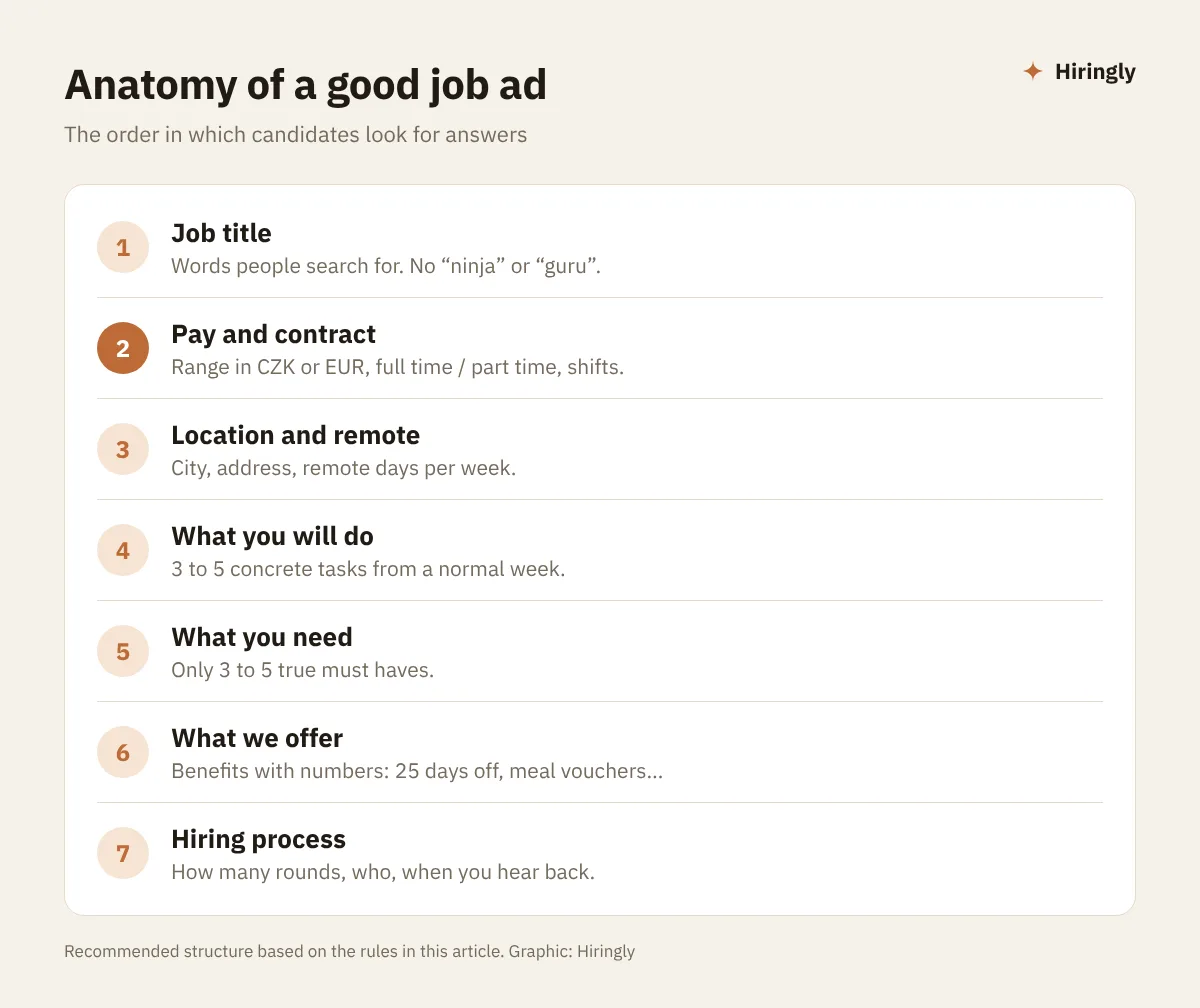
- Candidates scan an ad in a fixed order: title, pay, location, tasks, requirements. Build it the same way.
- Keep must haves to 3 to 5. A longer list mostly scares off strong applicants.
- Under the Czech government's draft law, employers will have to tell applicants the minimum pay and will not be allowed to ask about previous salary.
- The ad is only step one. Sorting the replies quickly and fairly matters just as much.
Why your job ad matters more than ever
The Czech market has loosened slightly over the past year, but people are still scarce. At the end of October 2026, the Labour Office registered 370,226 jobseekers and 106,252 vacancies, with unemployment at 5.0%. That is roughly 3.5 registered jobseekers per vacancy.
So candidates get to choose. And most ads do little to help them:
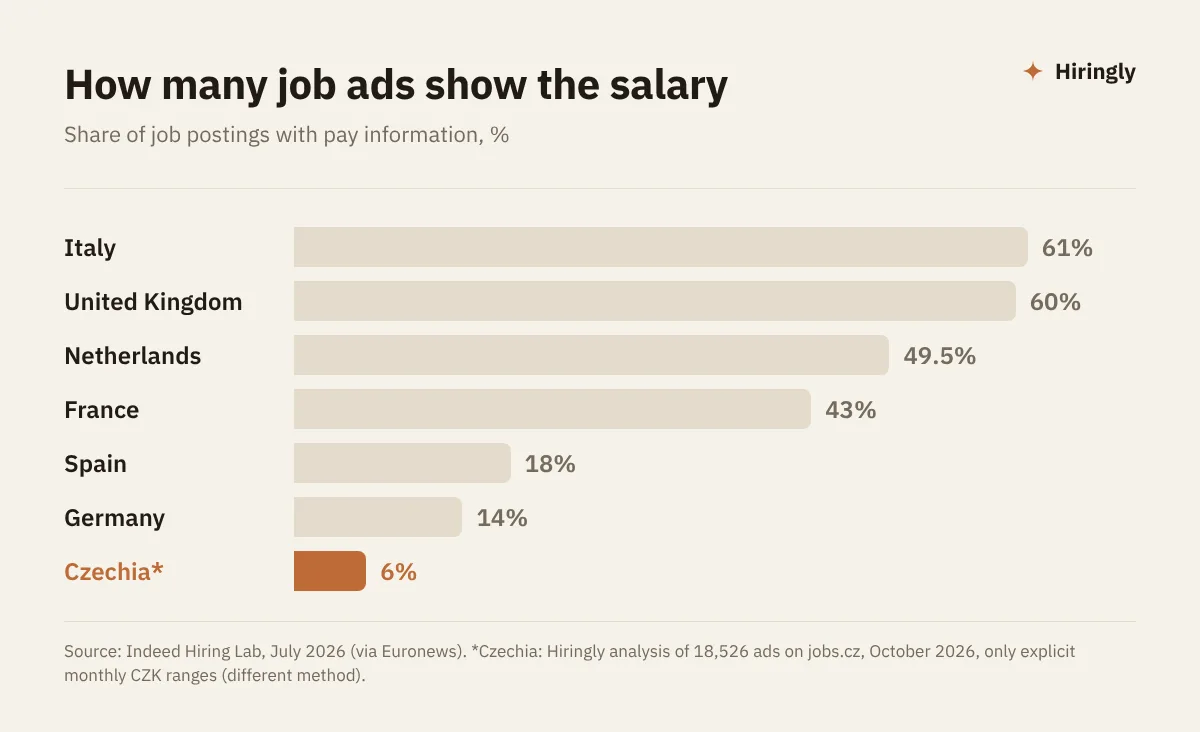
- In our analysis of 18,526 ads on jobs.cz, only about 6% gave a concrete monthly salary range in CZK.
- In Italy and the UK, more than 60% of postings show pay according to Indeed Hiring Lab data. In Germany it is 14%.
- In an Indeed survey of 6,011 European workers, between 61% (Germany) and 82% (Ireland) said they were more likely to apply when a salary range was listed.
9 rules for writing a job ad
1. Use the title people actually search for
Jobseekers type plain words like "accountant", "warehouse operative" or "Java developer". Nobody searches for "Customer Happiness Hero".
- Use the standard job title plus seniority: "Senior Accountant", "Production Operator (3 shifts)".
- Add location or contract type to the title only when it really matters for the role.
2. Put the pay at the top
Pay is the first thing a candidate looks for. If it is missing, some people close the tab and others apply blindly, only to drop out at the first interview.
- State a real range: "CZK 45,000 to 55,000 gross per month".
- For shift work, add premiums and a realistic average monthly income.
- For sales roles, separate base pay from commission.
3. Limit must haves to 3 to 5
A long list of requirements filters out exactly the people you want. Split it into two groups:
- Must have: things the job cannot be done without (for example a truck licence, double entry bookkeeping, B2 English).
- Nice to have: everything else. Keep it separate and short.
4. Describe a normal week, not a "dynamic environment"
Phrases like "young dynamic team" or "exciting challenges" say nothing. Candidates want to know what they will be doing on Monday morning.
- List 3 to 5 concrete tasks.
- Add numbers: team size, number of clients, order volumes.
5. Give benefits real numbers
Everyone reads "above standard benefits" as "none". Specifics work much better:
- 25 days of holiday instead of "extra holiday",
- meal vouchers worth CZK 150 a day instead of "meal allowance",
- 2 remote days a week instead of "hybrid possible".
6. Be clear about location, shifts and remote work
Name the city and ideally the district or industrial park. For production and warehouse roles, commuting is key: is there a bus that gets people there for the start of a shift?
For shift work, spell out the pattern (mornings, afternoons, nights, continuous operation) and whether shifts rotate.
7. Explain the hiring process
Nobody likes waiting in the dark. Two sentences are enough:
- how many rounds there are and who is involved,
- when you will reply, including to people you reject.
8. Make applying take under two minutes
Every extra form field cuts the number of completed applications. A CV, name, email and phone number are enough to start.
For blue collar and shift roles, let people apply with just a phone number, no CV needed.
9. Use neutral, plain language
Write for everyone and avoid gendered titles. Never ask for age, marital status or a photo.
Gender neutral job ads are also one of the principles of the EU Pay Transparency Directive.
Weak vs. strong job ad: a real world example
Same role, two approaches. Here is the difference for a warehouse job in Brno:
| Element | Weak ad | Strong ad |
|---|---|---|
| Title | Logistics Specialist | Forklift Warehouse Operative, Brno |
| Pay | Negotiable | CZK 38,000 to 44,000 + shift premiums |
| Tasks | Warehouse work | Picking, loading, scanner, forklift |
| Requirements | Responsible, flexible | Forklift licence, 2 shift pattern |
| Benefits | Above standard | 13th salary, free company bus |
| Process | We will contact selected candidates | Call within 3 days, then a site visit |
The figures above are illustrative. For real benchmarks by city and field, see our data on advertised Czech salaries.
What the pay transparency law changes
The EU deadline for transposing the Pay Transparency Directive passed on 7 June 2026, and the Czech Republic missed it. The government approved its draft amendment to the Labour Code on 31 August 2026 and proposes that it take effect on 1 January 2027.
According to the government draft as described by legal experts (ROWAN LEGAL, Podnikatel.cz), three things change for hiring:
- Minimum pay for applicants: employers will have to tell applicants, in a verifiable way, the minimum pay and other benefits on offer. This can happen in the ad, during the selection process or when negotiating the contract.
- No questions about salary history: "What are you earning now?" disappears from interviews, forms and ATS questionnaires. Candidates may still share it voluntarily.
- Covers short term contracts too: the rules also apply to the Czech DPP and DPČ agreements outside standard employment.
The draft does not strictly require pay in the job ad itself. But the ad is the simplest and best documented way to comply.
Note: the draft still has to pass the Chamber of Deputies and its wording may change. Check the final text before you update contracts and internal processes.
If you use AI in recruiting, also read our overview of EU AI Act deadlines for recruiting.
Checklist before you publish a job ad
Run through these 10 points before clicking "Publish":
- 1The job title matches what people search for.
- 2Pay is shown as a gross range (or at least a minimum).
- 3The contract type is clear: full time, part time, agreement, freelance.
- 4Work location and remote days are specific.
- 5The role description has 3 to 5 concrete tasks.
- 6There are only 3 to 5 must haves; the rest is "nice to have".
- 7Benefits have numbers.
- 8You describe the hiring process and when people will hear back.
- 9Applying takes under two minutes.
- 10There is no request for age, a photo or current salary.
When 300 CVs land in your inbox
A good ad brings more applicants. Then comes the second problem: reviewing them quickly and fairly.
The same principle helps. Score everyone against your 3 to 5 must haves, not against a gut feeling from the first line. We walk through it step by step in AI candidate screening.
If you would rather not sort by hand, Hiringly is a free AI ATS. It ranks applicants by how well they fit the role and explains why for each one. Data stays in the EU, and a human always makes the call on who gets an interview. Roles posted in Hiringly also appear on the public job board.
FAQ
Will I have to put the salary in every job ad from 2027?
Not in the ad itself, according to the Czech government draft. You will, however, have to give applicants the minimum pay in a verifiable way before the contract is signed. The draft may still change in parliament.
How long should a job ad be?
Long enough to answer seven questions: title, pay, location, tasks, requirements, benefits and process. That usually means 250 to 450 words.
Should I give a salary range or a single number?
A range works better. It leaves room for experience and still feels concrete. Keep it reasonably narrow, for example CZK 45,000 to 55,000.
Can I ask candidates what they earn now?
In the Czech Republic it is still allowed today, but the draft law would ban it. Ask about salary expectations instead and drop the current salary question now.
Can AI write my job ad?
Yes, as a first draft. But AI does not know what you really pay, what the shifts look like or what is truly essential for the role. You have to add that yourself.
AI recommends, a human decides.
Hiringly shows the reasoning for every candidate, stores data in the EU and never rejects anyone automatically.