Guide
Jobs AI will replace: 7 declining and 7 growing roles by 2030
Which jobs will AI replace and which will it create? CZSO and WEF data: 35% of Czech firms now use AI. Roles at risk, growing roles and skills to learn.
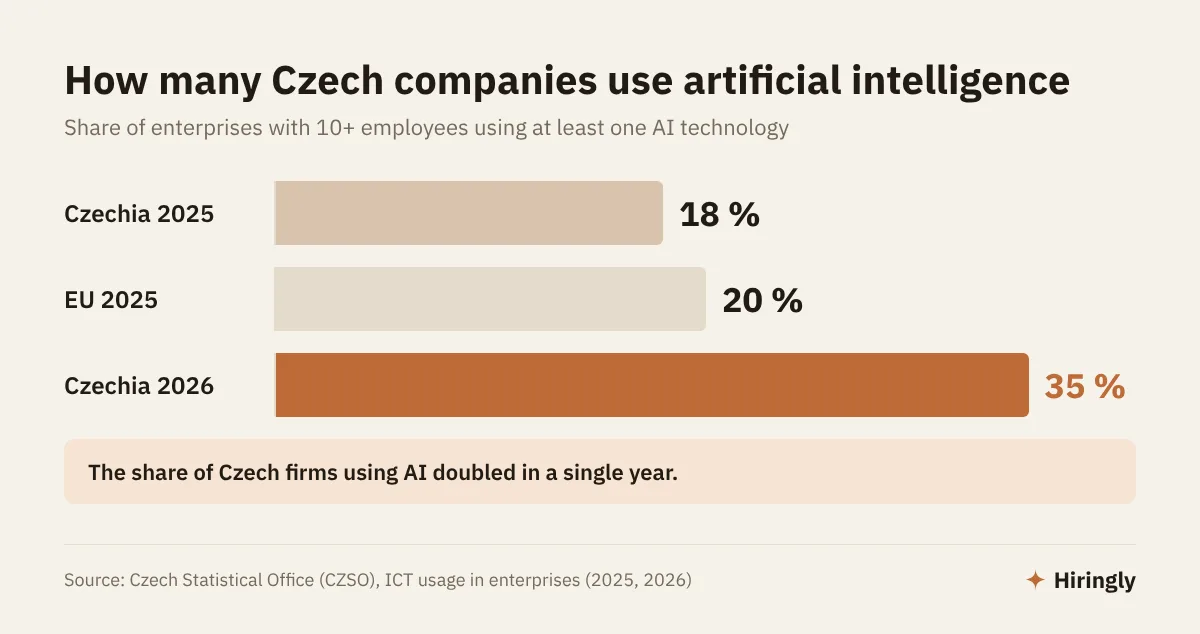
The share of Czech companies using artificial intelligence doubled in a single year. The question is no longer whether AI will change your job, but when and by how much. We went through the latest data from the Czech Statistical Office, the World Economic Forum and Czech research to see which jobs are shrinking, which are growing and what to do about it.
Key points
- In 2026, 35% of Czech companies with 10+ employees use AI, up from 18% a year earlier.
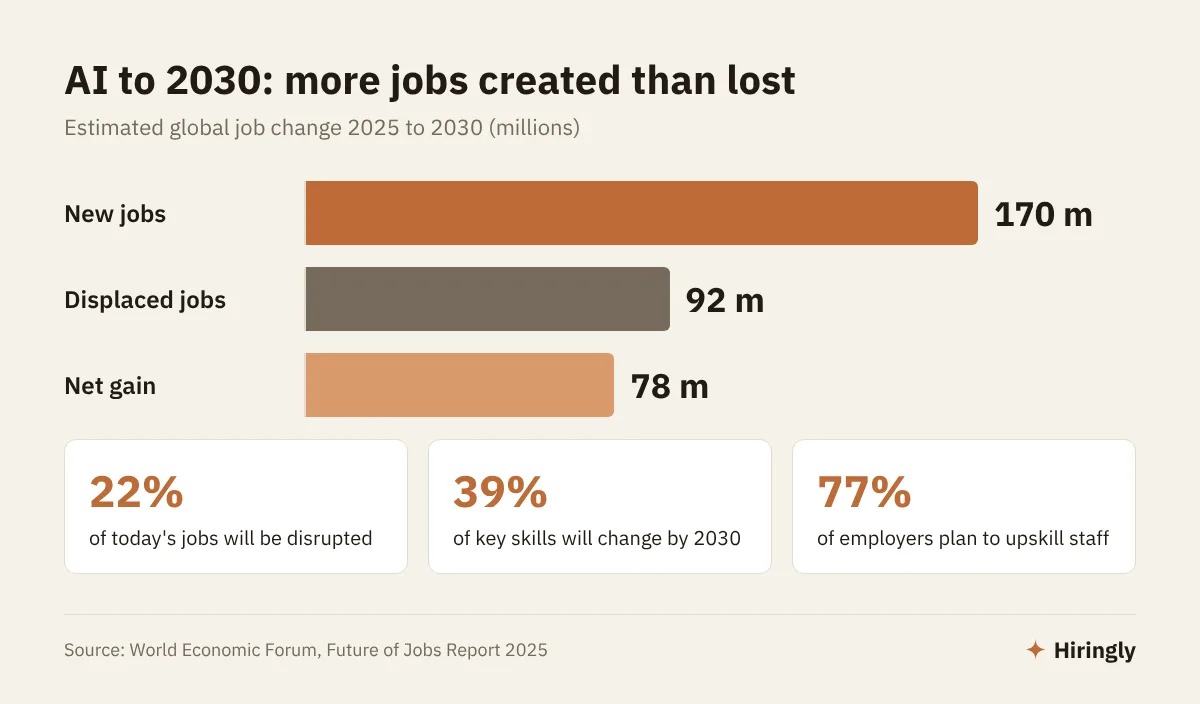
- The World Economic Forum expects 170 million jobs to be created and 92 million displaced by 2030. Net, work grows.
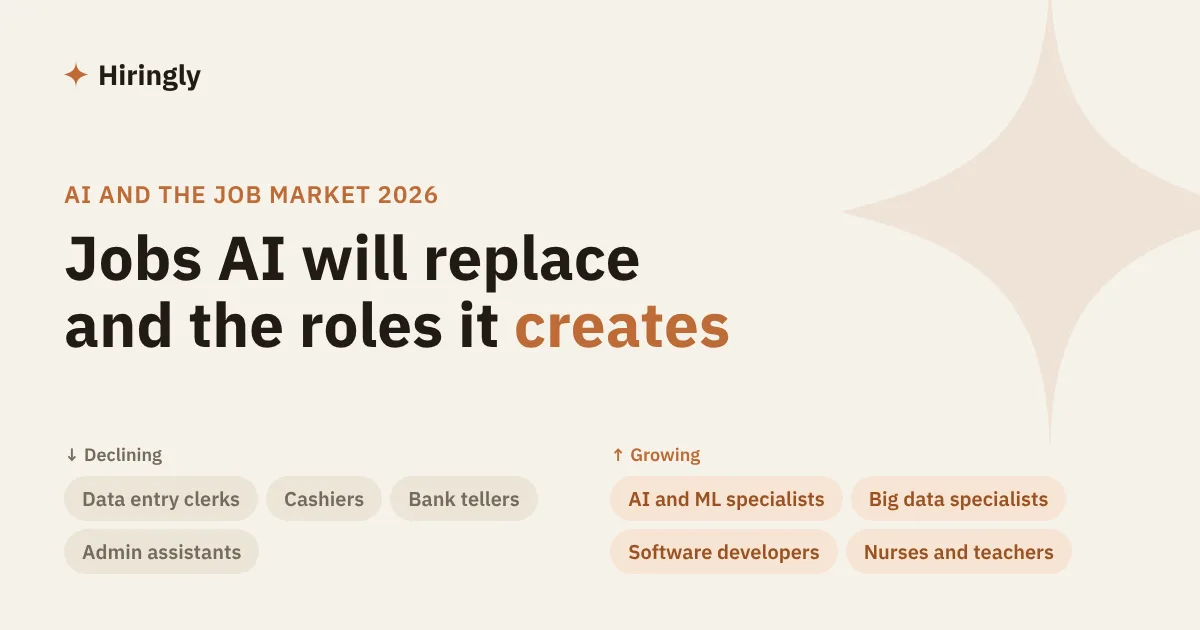
- Routine clerical roles face the highest risk: data entry, cashiers, bank tellers, admin support.
- Data and AI roles, developers and green energy grow fastest, and so do healthcare and teaching.
- Skills matter more than job titles. Close to 40% of them will change by 2030.
Czech companies are adopting AI faster than expected
In 2025, 18% of Czech enterprises used at least one AI technology. The EU average was 20%.
One year later, the Czech Statistical Office puts it at 35%. Large firms lead: roughly three in four use AI, compared with fewer than one in three small firms.
What companies actually use AI for
The CZSO data shows that, for now, AI in Czech firms mostly writes and sorts:
- generating text, code or speech: 31% of firms,
- generating images, video or music: about one in five firms,
- document analysis, search and chatbots: about one in five firms,
- machine learning for data analysis: 8% of firms.
These tasks make up a large part of office work. That is exactly where the impact shows first.
People are ahead of their employers
According to the CZSO, 32% of Czechs aged 16+ used AI in 2025. Among 16 to 24 year olds it was 78%. One in five working people used it for work.
For employers, the takeaway is simple: your new hires already know AI. The question is whether your company does.
Jobs AI will replace: 7 roles in decline
The World Economic Forum's Future of Jobs Report 2025 draws on more than a thousand large employers worldwide. The pattern is clear: work that is routine and rule-based is disappearing.
Czech data points the same way. An analysis by Technology Centre Prague estimates that generative AI could take over more than 60% of cognitive skills used in the Czech labour market within five years. For clerical groups and machine operators, it is over 70%.
| Role | Why it is shrinking | Where to move |
|---|---|---|
| Data entry clerk | Software reads and transcribes data | Data quality, data analysis |
| Cashier and ticket clerk | Self-checkouts, online sales | Customer care, complaints handling |
| Bank teller | Mobile banking | Advisory, fraud prevention |
| Postal service clerk | Digital communication | Logistics, delivery |
| Administrative assistant | AI schedules, drafts and sorts email | Office manager, project coordinator |
| Accounting and payroll clerk | Automated finance processes | Controlling, financial analysis |
| Production graphic designer | Image and variant generation | Art direction, brand and UX design |
Note: "in decline" does not mean "gone tomorrow". This is a trend to 2030 and it varies by company. Roles are often reshaped rather than cut: less retyping, more checking and communication.
Why these roles
They share three traits:
- they repeat and can be written down as a procedure,
- they deal with text or numbers, not people or the physical world,
- mistakes are easy to check, so companies are comfortable handing them to software.
7 roles growing because of AI
The good news: according to the WEF, 170 million new jobs will be created by 2030 and 92 million displaced. That is a net gain of 78 million jobs.
These roles grow fastest in percentage terms:
- 1Big data specialists. Companies have the data but lack people who turn it into decisions.
- 2Fintech engineers. Banks and payment firms keep moving services into apps.
- 3AI and machine learning specialists. They deploy, tune and monitor models.
- 4Software and application developers. AI speeds up their work, yet demand keeps rising.
- 5Autonomous and electric vehicle specialists. A key shift for the Czech automotive industry.
- 6Renewable energy and environmental engineers. Driven by the energy transition.
- 7Nurses and teachers. AI cannot replace care and teaching, and populations are ageing.
In absolute numbers, the WEF expects the biggest growth among farmworkers, delivery drivers and construction workers. AI still cannot do physical work in the field.
The skills that will decide
The WEF says 39% of core skills will change by 2030. Demand is rising fastest for:
- AI and big data,
- networks and cybersecurity,
- technological literacy,
- creative and analytical thinking,
- resilience, flexibility and a drive to keep learning.
Notice the balance: two of the five most important skill groups are purely human.
What employers should do: 6 steps
According to the WEF, 77% of employers plan to upskill their staff and 41% expect to reduce headcount because of AI. Companies that want to keep both people and performance can act like this:
- 1Map the routine. For every role, write down how much time goes into repetitive tasks.
- 2Reshape, don't cut. An assistant can become a project coordinator. That is cheaper than a new hire.
- 3Invest in training. A short AI course pays back faster than a month of searching for a new person.
- 4Rewrite your job ads. Instead of "MS Office skills", ask for "can work with AI tools and verify the output".
- 5Watch the regulation. AI in hiring falls under strict rules, see our guide to the EU AI Act in recruiting.
- 6Automate your own HR too. Sorting hundreds of CVs is exactly the kind of routine AI handles well. Hiringly, for example, is a free AI ATS: it ranks applicants by fit, explains why for each one, keeps data in the EU and always leaves the decision to a person.
To see where Czech employers hire the most, read our analysis of 18,526 job ads.
What employees should do: a checklist
If your role is on the list above, don't panic. You have time, but don't wait.
- I use AI at work at least once a week, not just out of curiosity.
- I know which of my tasks repeat, and I know how to speed them up.
- I have one skill AI lacks: negotiation, leading people, expert judgement.
- I have completed at least one course or certification in the past year.
- My CV shows results, not just duties. See our ATS-friendly CV guide to get past AI screening.
- I keep an eye on which roles companies are hiring for, for example on the Hiringly job board.
FAQ
Which jobs will AI replace first?
Those with the most routine work with text and numbers: data entry, cashiers, bank tellers, postal and administrative clerks. The WEF lists them among the fastest-declining roles.
Will AI destroy more jobs than it creates?
The WEF's global estimate says no: 170 million jobs created and 92 million displaced by 2030. Economies with a large share of manufacturing and administration, like Czechia, will still feel the shift and need reskilling.
How many Czech companies already use AI?
According to the CZSO, 35% of companies with 10+ employees in 2026, up from 18% a year earlier.
Which jobs are most resistant to AI?
Technology Centre Prague points to management, healthcare, science and engineering. Skilled trades and field work, which need physical presence and judgement, are also resilient.
Will AI replace recruiters?
Unlikely. AI takes over screening and admin, while the conversation with the candidate, judgement and the final decision stay with people. European AI regulation requires human oversight here too.
AI recommends, a human decides.
Hiringly shows the reasoning for every candidate, stores data in the EU and never rejects anyone automatically.