Guide
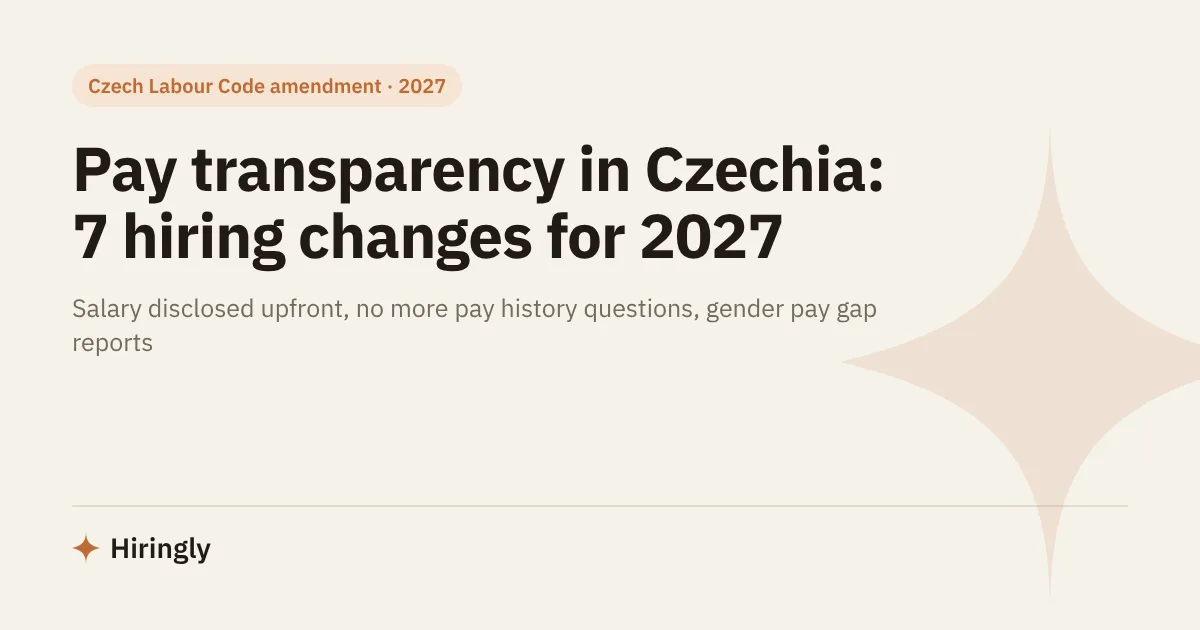
Pay transparency in Czechia: 7 hiring changes coming in 2027
Salary disclosed upfront, no pay history questions, gender pay gap reports. What the Czech pay transparency law means for hiring and how to prepare.
"What were you earning in your last job?" is one of the most common questions in Czech job interviews. Under the government's draft amendment to the Labour Code, it becomes illegal from 2027. Here is what changes for hiring in the Czech Republic, who it applies to and what to do before the new rules land.
Key points
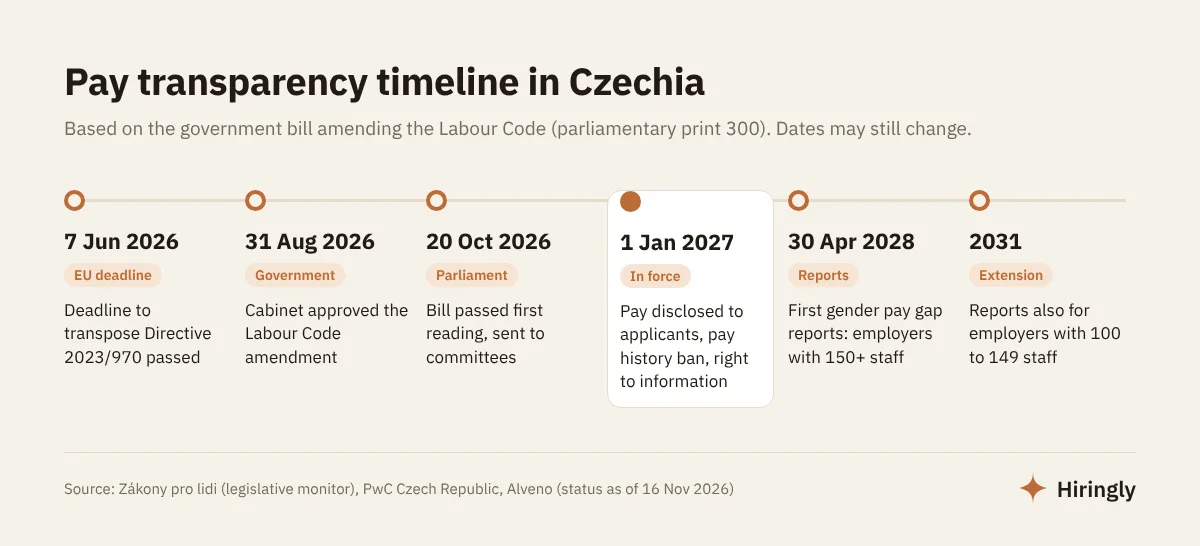
- The Czech Labour Code amendment transposes the EU Pay Transparency Directive 2023/970. The proposed start date is 1 January 2027.
- Candidates must learn the minimum pay on offer before contract talks begin. Asking about previous pay will be banned.
- Employers with 150+ staff report their gender pay gap from 2028, and those with 100+ staff from 2031.
- Job ads that show a salary get 47.7% more responses on average, according to JenPráce.cz data.
- The bill has not been passed yet. Details may still change in Parliament.
Where the bill stands
Member states had until 7 June 2026 to transpose Directive (EU) 2023/970. Czechia missed the deadline.
The government approved the bill on 31 August 2026, and it passed its first reading in the Chamber of Deputies on 20 October, according to the Zákony pro lidi legislative monitor. Práce a mzda reports that MPs cut the committee review period to 30 days.
Why the fuss? Czechia has one of the widest gender pay gaps in the EU. Eurostat put it at 18.5% for 2024, second only to Estonia (Seznam Zprávy). The EU average is 11.1% (The Brussels Times, citing Eurostat).
7 changes coming to hiring and pay
1. Candidates learn the pay upfront
Every employer, regardless of size, must tell candidates the minimum pay on offer before contract negotiations start (PwC).
The Czech draft does not make salaries mandatory in job ads (EY). But you must be able to prove you shared it, so put it in writing: in the ad, the interview invitation or an email.
2. No more pay history questions
Asking candidates about their previous or current salary will be prohibited. Asking about salary expectations is still fine.
The labour inspectorate can fine breaches. The amount differs between versions of the bill; Alveno cites up to CZK 200,000.
3. A pay structure based on objective criteria
Every employer will need a clear pay system based on the value of work: skills, effort, responsibility and working conditions.
Not having one could cost up to CZK 1,000,000 under the draft (PwC).
4. Employees can ask for averages
Employees can request, in writing, their own pay and the average pay in their job category, broken down by gender. Employers have two months to reply and must remind staff of this right regularly.
In small teams where an answer would reveal a colleague's salary, the data goes through the Public Defender of Rights instead.
5. Pay secrecy clauses no longer hold
Stopping employees from discussing their own pay has been illegal since 1 June 2025 (Section 346a of the Labour Code, Alveno). If your contracts still carry a pay confidentiality clause, remove it.
6. Gender pay gap reporting
Larger employers will publish pay gaps between men and women. Under the draft:
- 250+ employees: every year, first by 30 April 2028 for 2027 data,
- 150 to 249 employees: first in 2028, then every three years,
- 100 to 149 employees: first in 2031, then every three years,
- under 100 employees: no mandatory report.
7. A gap of 5% or more triggers a joint pay assessment
If a report shows an unjustified gap of at least 5% in any job category and the employer does not close it within six months, it must run a joint pay assessment with unions or the works council (PwC).
Article 18 of the directive also shifts the burden of proof in equal pay disputes to the employer (EUR-Lex).
Who has to do what: the overview
| Obligation | Applies to | From (draft) |
|---|---|---|
| Minimum pay disclosed to candidates | all employers | 1 Jan 2027 |
| Ban on pay history questions | all employers | 1 Jan 2027 |
| Pay structure and right to information | all employers | 1 Jan 2027 |
| Annual pay gap report | 250+ employees | 2028 |
| Report every 3 years | 150 to 249 employees | 2028 |
| Report every 3 years | 100 to 149 employees | 2031 |
Sources: PwC, Alveno. This is a government bill and Parliament may amend it.
Salary in the job ad: not required, but it pays off
Even though the law will not force you to publish pay in the ad, it is worth doing. JenPráce.cz data published by Seznam Zprávy shows ads with a salary get 47.7% more responses on average.
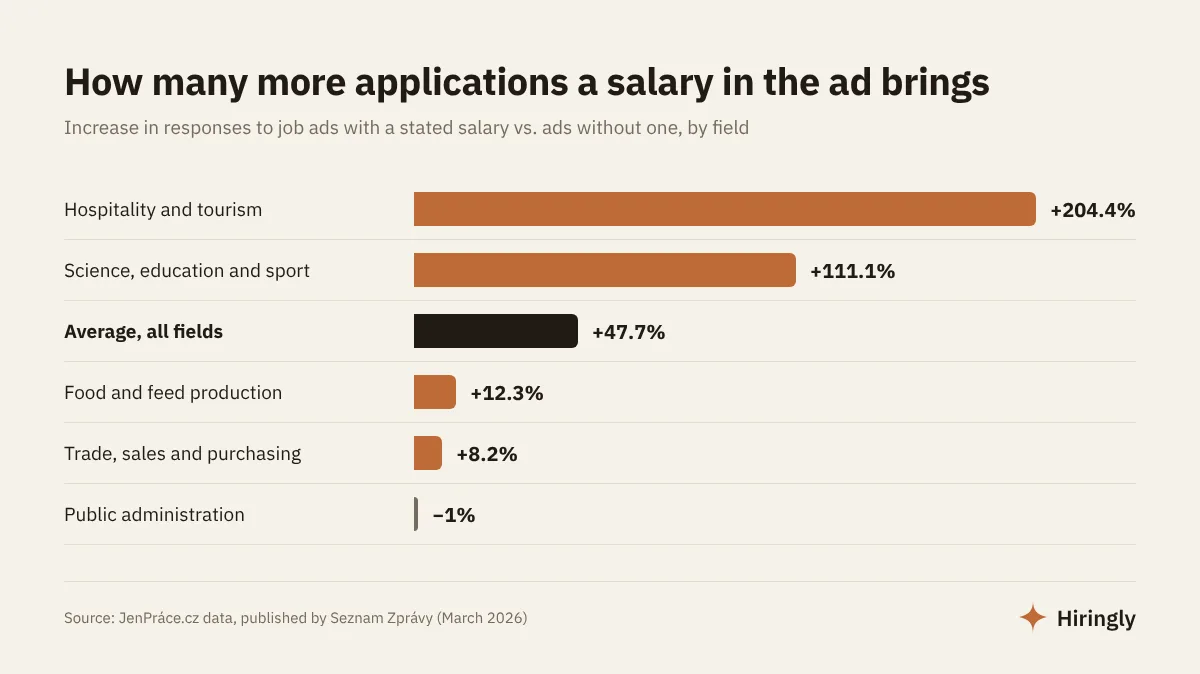
The differences between fields are striking:
- hospitality and tourism: up to 204.4% more responses,
- science, education and sport: 111.1% more,
- trade and sales: only 8.2% more,
- public administration: practically no change, since pay scales are already public.
For shift work and seasonal roles, a visible salary is your strongest lever. For more on writing ads that attract the right people, see How to write a job ad: 9 rules. For current statutory pay floors, check our guide to the Czech minimum wage 2027.
More responses also mean more CVs to read. An AI ATS can help by ranking applicants by fit and explaining why for each one. Hiringly does this for free, keeps data in the EU and always leaves the interview decision to a person.
Checklist: what to do before the end of 2026
- 1Review your interview templates. Remove questions about previous or current pay from scripts, forms and your ATS.
- 2Set a pay range for every open role. You must share the minimum with candidates in writing.
- 3Decide where you disclose pay. The job ad is easiest; otherwise use the interview invitation.
- 4Write down your pay structure. Define the criteria: skills, responsibility, effort, conditions.
- 5Map equal-value job categories. Without them you cannot calculate averages or gaps.
- 6Run an internal test. Calculate the gender gap in each category. Above 5%, look for an objective reason.
- 7Clean up contracts. Remove clauses that forbid employees from discussing pay.
- 8Train recruiters and managers. One wrong interview question could cost hundreds of thousands of crowns.
Note: the amendment has not been passed yet. Watch the second and third readings in Parliament, as dates and fines may still change.
If you use AI in hiring, the AI Act and GDPR apply too. We summarised them in our GDPR and EU AI Act checklist for recruiting. To see how employers already show pay in their ads, browse the Hiringly public job board.
FAQ
Will salaries have to be in Czech job ads from 2027?
Not under the current government bill. But candidates must receive the minimum pay on offer, in a provable form, before contract talks start. The job ad is the simplest way to comply.
Can I still ask candidates what they expect to earn?
Yes. Only questions about previous or current pay will be banned. Salary expectations remain a fair question.
Does pay transparency apply to small companies?
Partly. Disclosing pay to candidates, the pay history ban and employees' right to information apply to everyone. Gender pay gap reporting starts at 100 employees.
Do the rules cover DPP and DPČ agreements?
According to Práce a mzda, the bill also covers work performed under these agreements. Plan for it with part-time and seasonal staff too.
When will the law be final?
That is not certain yet. After committees, the bill faces second and third readings, then the Senate and the President's signature. The proposed start date is 1 January 2027.
This article reflects the government bill as of 16 November 2026 and is not legal advice.
AI recommends, a human decides.
Hiringly shows the reasoning for every candidate, stores data in the EU and never rejects anyone automatically.