Guide
Employee onboarding checklist: a 90-day plan for new hires
An employee onboarding checklist with a 90-day plan, legal must-dos for employers in Czechia and 7 common mistakes. Backed by BambooHR and Gallup data.
A new hire signs the contract, shows up, and six weeks later hands in their notice. The job ad, the interviews and the training are money down the drain, and you are back to square one. Most of the time the problem is not who you hired, but how their first weeks went. This employee onboarding checklist gives you a 90-day plan, the legal must-dos for employers in Czechia, and the mistakes worth avoiding.
Key points
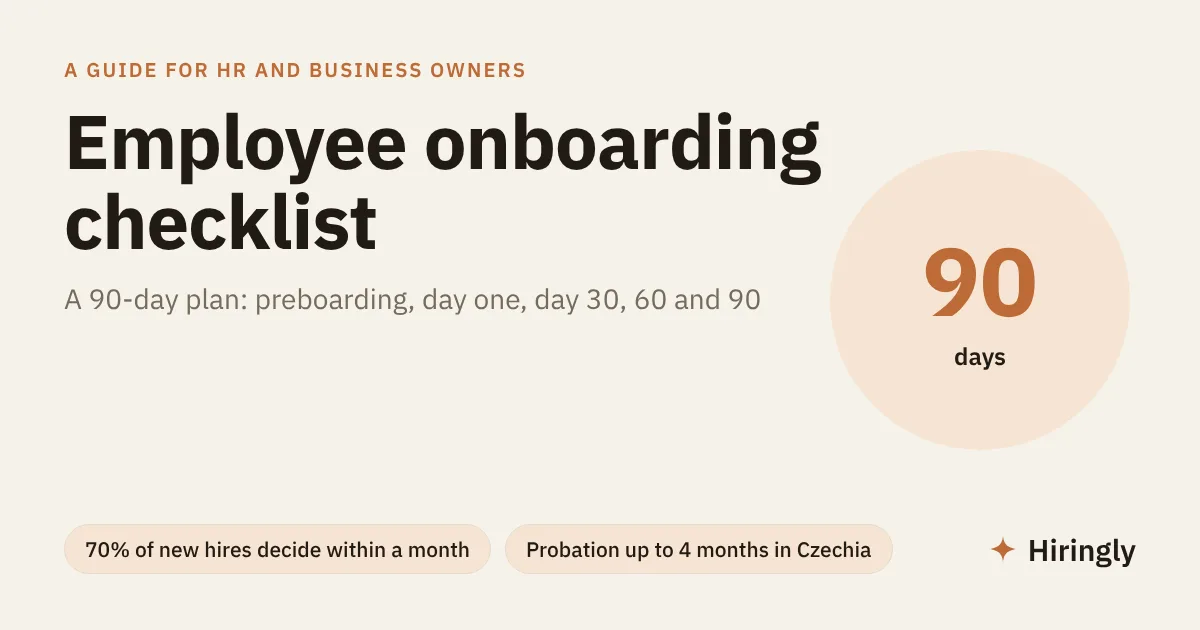
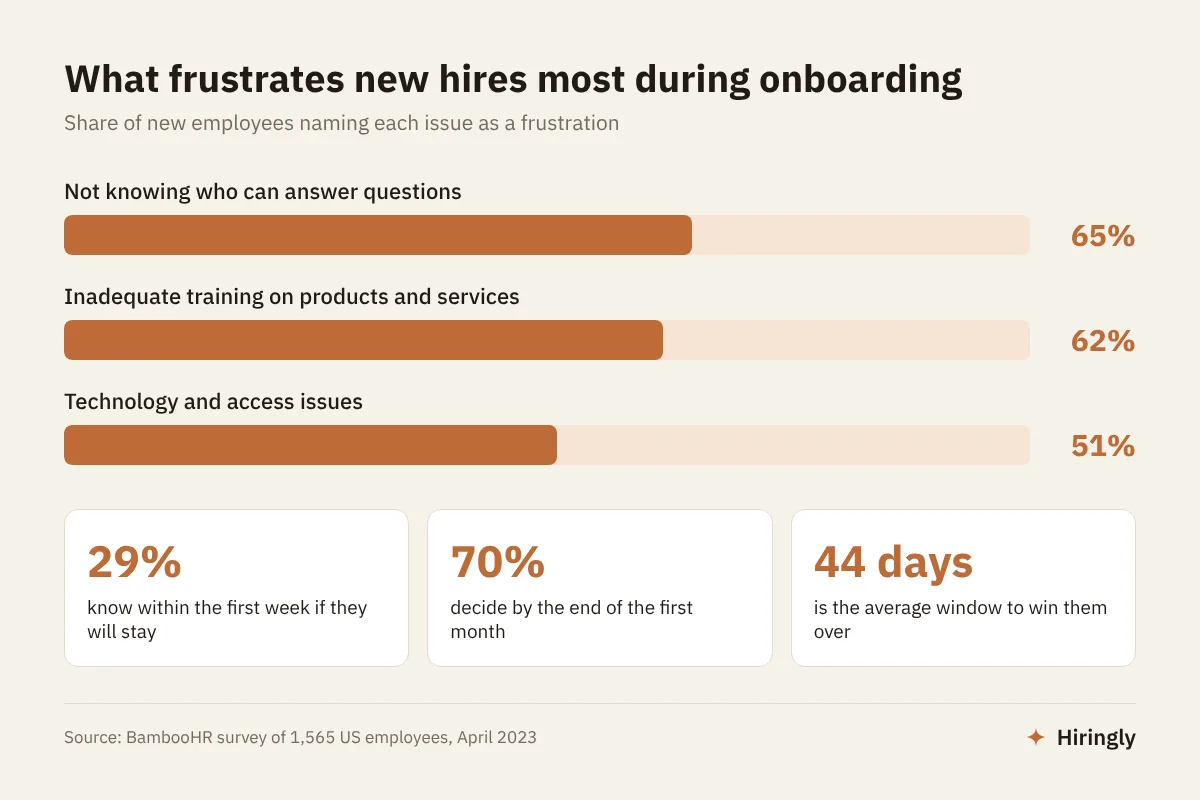
- BambooHR found that 70% of new hires decide within their first month whether the job is right for them. Employers have about 44 days to win them over.
- Only 12% of employees strongly agree their organization onboards new people well, according to Gallup.
- In Czechia the probation period can now last up to 4 months (8 for managers), so a 90-day plan leaves room for a fair review.
- Czech employers must give new staff written information about the terms of employment within 7 days.
- The biggest pitfalls: no one to ask, information overload, and no buddy.
Why onboarding matters more than you think
Onboarding covers everything from the signed offer to the moment a new hire can do the job confidently on their own. Many companies squeeze it into one day of paperwork. The data says that is an expensive shortcut.
The first month decides
A 2023 BambooHR survey of 1,565 US employees shows how fast people make up their minds:
- 29% of new hires know within the first week whether the job fits.
- 70% decide within the first month.
- 44% have second thoughts during their first week.
- On average, employers have 44 days to convince a new hire to stay.
Most companies get it wrong
According to Gallup, only 12% of employees strongly agree that their organization does a great job onboarding new staff. The same piece cites SHRM estimates that turnover can reach up to 50% in the first 18 months, and that replacing someone costs six to nine months of that person's salary.
For a role paying CZK 50,000 a month, that estimate puts one failed hire at CZK 300,000 to 450,000.
Legal must-dos for employers in Czechia
If you hire in Czechia, some onboarding steps are required by the Labour Code, and skipping them can lead to fines.
| Obligation | Deadline | Watch out for |
|---|---|---|
| Agree a probation period | on the start date at the latest | in writing only, max 4 months (managers 8) |
| Written terms of employment | within 7 days of the start | pay, hours, holiday, notice period |
| Health and safety training | before work starts | record who trained whom and when |
| Extending probation | only while it is running | by mutual agreement, never one-sided |
Probation after the 2025 "flexi" amendment
Since 1 June 2025, probation can last up to 4 months for regular employees and up to 8 months for managers (Section 35 of the Labour Code). It must be agreed in writing by the first day of employment and is extended by full days of holiday or other absences. Breaking the rules can cost up to CZK 2,000,000 in fines (Money.cz).
Written information within 7 days
If the contract does not cover everything, employers must inform employees in writing about pay, payday, working hours, holiday, notice period and more, within 7 days of the start (Section 37, Czech Ministry of Labour). The easy fix: add this document to the contract signing pack.
Note: probation cannot be extended after it has ended or by a one-sided notice. Such an agreement is invalid.
The 90-day onboarding plan, step by step
Why 90 days? With probation now up to 4 months, a review at the end of month three still leaves time to decide, or to course-correct.
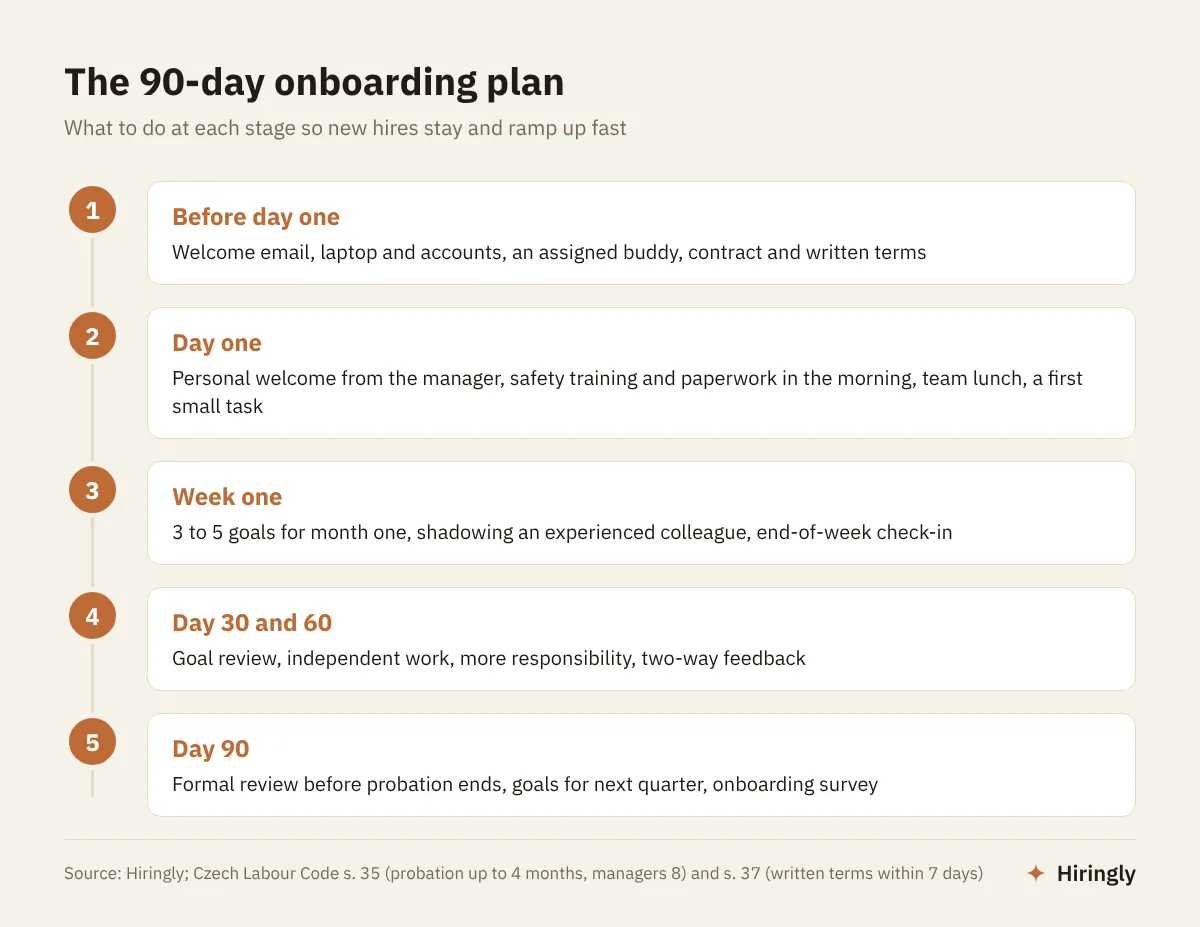
Before day one (preboarding)
- Send a welcome email: when and where to arrive, who to ask for, what to bring.
- Set up the laptop, accounts, email, time tracking and any workwear.
- Assign a buddy, ideally a teammate rather than the manager.
- Prepare the paperwork: contract, written terms, salary statement.
- Tell the team who is joining and what they will work on.
Day one
- The manager welcomes the new hire in person, not just reception or HR.
- Get safety training and paperwork done in the morning so the afternoon is about people.
- Give a tour and introduce the key colleagues.
- Lunch with the team or the buddy.
- One small, achievable task. An early win builds momentum.
Week one
- Agree 3 to 5 goals for the first month, specific and measurable.
- Let the new hire shadow an experienced colleague. BambooHR found 93% of new hires want exactly that.
- End the week with a short check-in: what works, what is missing, who to ask.
Day 30
- Review the goals set in week one.
- The new hire now handles smaller tasks independently.
- Ask openly: "Is the job what we promised in the ad and the interview?"
Day 60
- More responsibility: a first own project or a solo shift.
- Two-way feedback. Fresh eyes spot problems you no longer see.
Day 90
- A formal review before probation ends.
- Goals for the next quarter and a development plan.
- A short anonymous onboarding survey to improve the process for the next hire.
Example: shift-based roles
Picture a manufacturer near Pilsen hiring ten operators for a three-shift operation. The classic mistake is putting them on night shift from day one. A better plan: morning shifts with a buddy in week one, afternoons in week two, nights from week three. For temps and shift workers, the first shift often decides whether they come back for the second.
7 common onboarding mistakes
- 1No one to ask. It is the top frustration, named by 65% of new hires (BambooHR). A buddy and a one-page contact list fix it.
- 2Too much at once. In the 2025 TalentLMS and BambooHR report, 42% said onboarding overwhelmed them with information.
- 3Admin over training. 52% said onboarding focused more on admin than on practical job training (same report).
- 4Broken tech. Missing accounts and equipment frustrate 51% of new hires (BambooHR).
- 5Onboarding ends on day one. Per TalentLMS, only 40% felt fully integrated within two weeks (8% on day one, 32% within two weeks). The rest needed longer, and 9% took six months or more.
- 6No goals. If people do not know what success looks like, they cannot pass probation.
- 7No one asks for feedback. Then the first sign of doubt is a resignation letter.
Good onboarding starts with good hiring
No onboarding plan can rescue a hire who was wrong for the role. Much of the outcome is decided earlier: in a clear job ad and a fair shortlist.
If each ad brings in dozens or hundreds of CVs, AI candidate screening can help. Hiringly, for example, is a free AI ATS that ranks applicants by fit and explains why for each one. Data stays in the EU and a person always makes the decision. You can also list open roles on the public job board.
Handling personal data of applicants and new hires? See our GDPR and EU AI Act checklist for recruiting.
FAQ
How long should employee onboarding last?
Ideally the full probation period, so at least 90 days. In the 2025 TalentLMS and BambooHR survey, only 40% felt fully integrated within two weeks (8% on day one, 32% within two weeks), and 9% needed six months or more.
Who owns onboarding: HR or the hiring manager?
Both. HR builds the process, paperwork and training. The direct manager, supported by a buddy, owns goals, feedback and day-to-day support.
How long is probation in Czechia in 2026?
Up to 4 months for regular employees and up to 8 months for managers, under the Labour Code amendment in force since 1 June 2025. For fixed-term contracts it cannot exceed half the contract length.
Do small businesses and temps need onboarding too?
Yes, just a lighter version. For a temp worker, a welcome message, a buddy for the first shift, safety training and a quick check-in after week one are enough. It takes an hour and saves you a rehire.
AI recommends, a human decides.
Hiringly shows the reasoning for every candidate, stores data in the EU and never rejects anyone automatically.