Guide
How to reduce time to hire: 7 steps to fill a role in 3 weeks
Median time to hire is 38 days. Learn how to reduce time to hire to 3 weeks: 7 steps, a checklist and data on where hiring processes lose time.
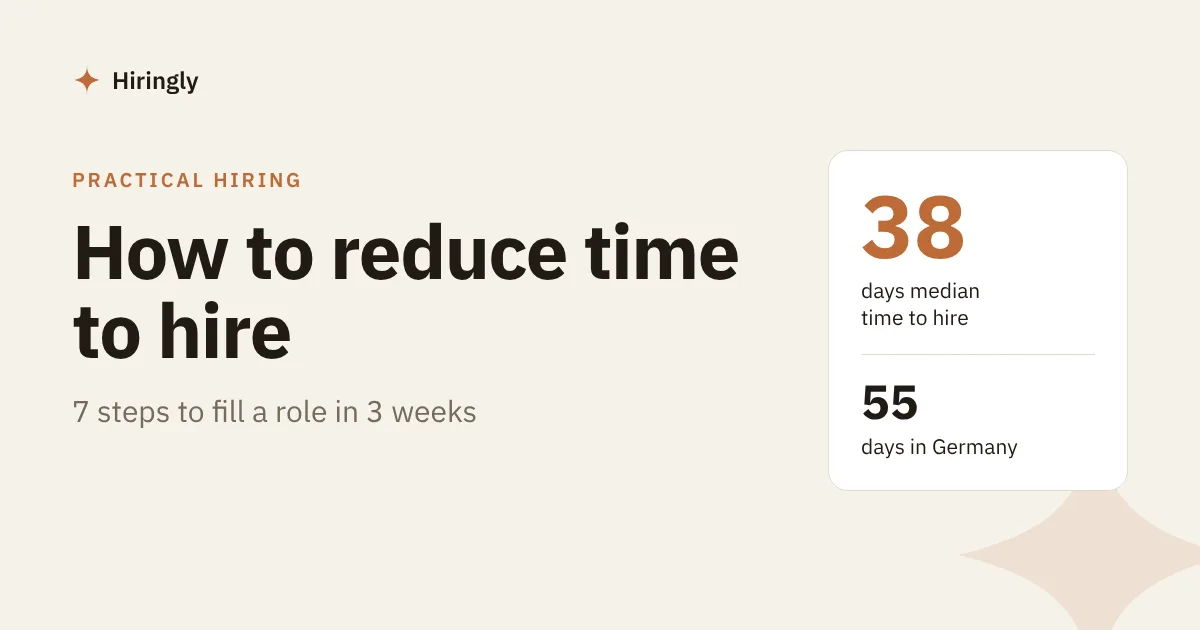
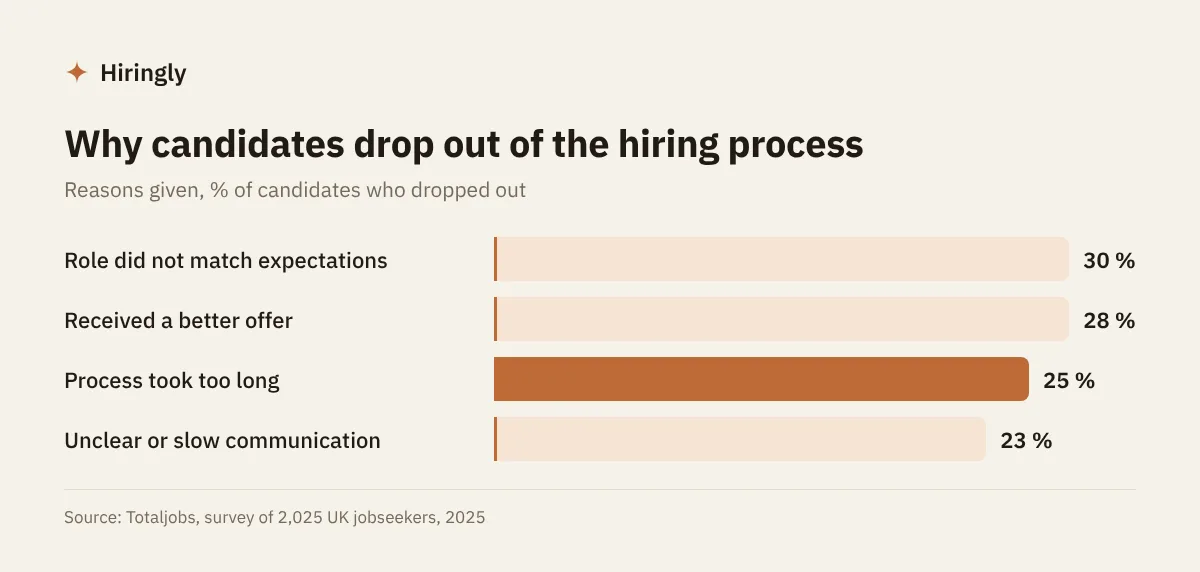
Filling a single role takes a median of 38 days worldwide. The best candidates rarely wait that long: among people who quit a hiring process, one in four leaves because it simply took too long. Here is how to reduce time to hire to three weeks without lowering the bar.
Key points
- The median time from application to hire is 38 days, and 55 days in Germany.
- Most of that time is waiting: for CV review, for interview slots and for a decision.
- Companies that use AI in hiring hire 26% faster on average, saving 11 days.
- Two interview rounds, pre-booked slots and a decision within 48 hours make the biggest difference.
- In Czechia there are only about 3.5 registered jobseekers per vacancy, so speed is a competitive edge.
Why hiring speed matters right now
The Czech labour market remains tight. According to the Czech Labour Office, on 31 October 2026 there were 370,226 registered jobseekers and 106,252 open vacancies. The unemployment share held at 5.0%.
That works out to roughly 3.5 registered jobseekers per vacancy, and far fewer in skilled roles. If you decide slowly, you lose candidates to whoever sends an offer first.
How long hiring takes elsewhere
Global data from SmartRecruiters (Recruiting Benchmarks 2025/2026) show wide gaps between countries and industries:
- Global median: 38 days from application to hire.
- Germany: 55 days, the slowest of the countries tracked.
- Industries: retail 25 days, technology 48 days, manufacturing 55 days.
- Volume: 73 applicants per role on average.
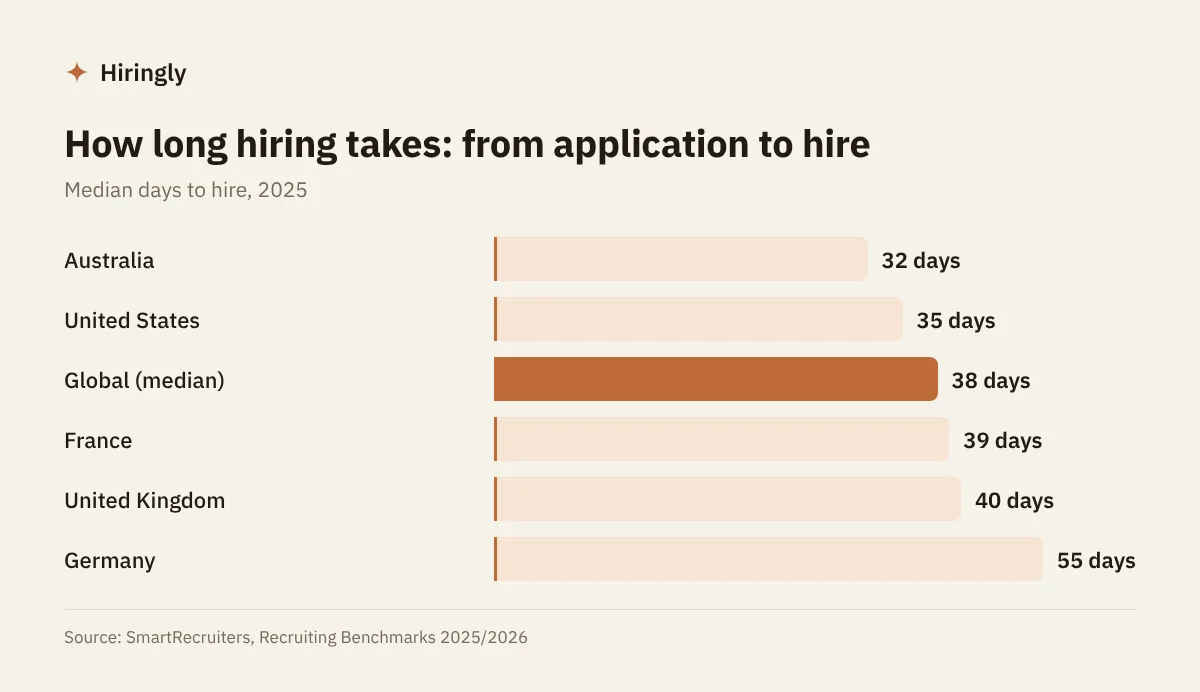
And the trend is heading the wrong way. Gem's 2025 Recruiting Benchmarks found time to hire grew from 33 days in 2021 to 41 days. Interviews per hire rose from 14 to 20.
Where hiring processes lose the most time
The actual work of hiring does not take 38 days. Most of the time, a role just sits there waiting for the next step. A Totaljobs survey of 748 recruiters points to the usual bottlenecks:
- Irrelevant applications: 72% of recruiters say screening unsuitable CVs slows them down.
- Manual admin: 17.7 hours per vacancy on average, more than two working days.
- Too many rounds: 36% admit their company has too many interview stages.
- Busy managers: chasing calendar slots and waiting on hiring manager feedback.
Candidates respond in kind. 28% of jobseekers surveyed had dropped out of a hiring process. A quarter of them left because it took too long, and another 23% because communication was unclear or slow.
Where time leaks and how to win it back
| Hiring stage | Typical bottleneck | Target time |
|---|---|---|
| Role briefing | vague requirements, no budget | 1 day |
| CV screening | hundreds of applications, manual reading | within 48 hours |
| First contact | email ping-pong over dates | within 5 days of applying |
| Interviews | 3 or more rounds, manager unavailable | 2 rounds within 1 week |
| Decision and offer | waiting for sign-off | within 48 hours of the final round |
How to reduce time to hire: 7 steps
1. Start with a 30-minute briefing
Most delays start on day one. Before the job ad goes live, sit down with the hiring manager and agree on:
- 3 to 5 must-have requirements (what is essential and what is just a plus),
- the salary range the company will actually pay,
- who decides and who joins the interviews,
- concrete interview slots for the next two weeks.
2. Write a job ad that screens for you
A clear ad discourages poor-fit applicants and saves you hours of reading. Include the salary, the actual work and the must-haves. In the Totaljobs survey, 35% of candidates said more salary transparency would keep them engaged.
For the full method, see How to write a job ad: 9 rules.
3. Screen CVs daily, not weekly
The strongest candidates apply in the first few days. If you wait until "enough" applications pile up, you lose them. Set a simple rule: every applicant hears back within 48 hours.
For roles with hundreds of applicants, AI helps. SmartRecruiters reports that companies using AI hire 26% faster, about 11 days sooner. Hiringly, for example, is a free AI ATS that ranks applicants by fit and explains each ranking. Data stays in the EU and a person always decides who gets an interview. Read more in AI candidate screening.
4. Replace round one with a 15-minute call
A short call checks the essentials: motivation, salary expectations, availability and language skills. It saves time on both sides, and only the people who truly fit get invited to a full interview.
5. Two rounds maximum, with pre-booked slots
Every extra round means another hunt for dates and more days of waiting. For most roles, two rounds are enough:
- 1Skills interview with the future manager (optionally with a short practical task).
- 2Final meeting with the team or leadership.
Block the slots in the manager's calendar during the briefing. Then you offer candidates concrete times instead of trading emails.
6. Decide within 48 hours
Score every candidate against the same criteria in a simple scorecard. Fill it in right after the interview while impressions are fresh. A decision within two days is fair to the candidate and protects you from a competing offer.
7. Communicate and send the offer fast
Get back to the people you do not hire, too. A candidate who knows where they stand will not drop out because of silence. Send a written offer within 24 hours of the decision and plan day one right away. Our 90-day onboarding checklist will help.
Three typical Czech scenarios
A manufacturer near Plzeň hiring shift operators. Speed wins here, since applicants usually talk to several employers at once. What works: a call within 24 hours of the application, an interview combined with a shop-floor tour, and an offer the same day.
An e-commerce company in Brno hiring customer support. The ad draws hundreds of responses. What helps: a clearly stated salary, a short written task instead of round one, and screening CVs every single day.
A software company in Prague hiring developers. Candidates often juggle several offers. The key is not adding extra rounds and giving feedback within two working days after each step.
Note: moving faster does not mean cutting corners. Follow GDPR when screening CVs and never assess age, marital status or photos.
Checklist: hire in 3 weeks
Print this plan and use it for every new role:
- Day 1: manager briefing, requirements, salary, interview slots booked.
- Days 1 to 2: job ad live with salary and clear must-haves.
- Days 2 to 10: daily CV screening, every applicant answered within 48 hours.
- Days 4 to 10: 15-minute calls with shortlisted candidates.
- Days 8 to 15: skills interview and final round.
- Days 15 to 17: scorecard decision, written offer.
- Days 18 to 21: offer accepted, others informed, start date planned.
Want to see how other companies advertise their roles? Browse the Hiringly public job board.
FAQ
What is the average time to hire?
According to SmartRecruiters, the global median is 38 days from application to hire. It varies by industry: 25 days in retail, 48 in technology and 55 in manufacturing.
What is the difference between time to hire and time to fill?
Time to hire measures the period from a candidate's application (or first contact) to accepting the offer. Time to fill covers the whole period from opening the role to filling it. For the speed of the hiring process itself, time to hire is the more precise metric.
Does faster hiring hurt candidate quality?
Not if you cut waiting rather than evaluation. Clear requirements, the same criteria for everyone and structured interviews tend to improve quality. You only remove idle time between steps.
How many interview rounds are ideal?
For most roles, two rounds preceded by a short phone call. Every extra round stretches the process and raises the risk that the candidate accepts another offer.
Can AI decide whether to hire someone?
No. AI can rank CVs and explain why, but a person always decides who gets interviewed and hired. When you use AI in hiring, keep the EU AI Act rules in mind.
AI recommends, a human decides.
Hiringly shows the reasoning for every candidate, stores data in the EU and never rejects anyone automatically.