Guide
Average salary in Czech Republic 2026: CZK 51,966 and the real picture
The average salary in the Czech Republic hit CZK 51,966 in 2026, but the median is CZK 44,337. Regional data, net pay and what it means for hiring.
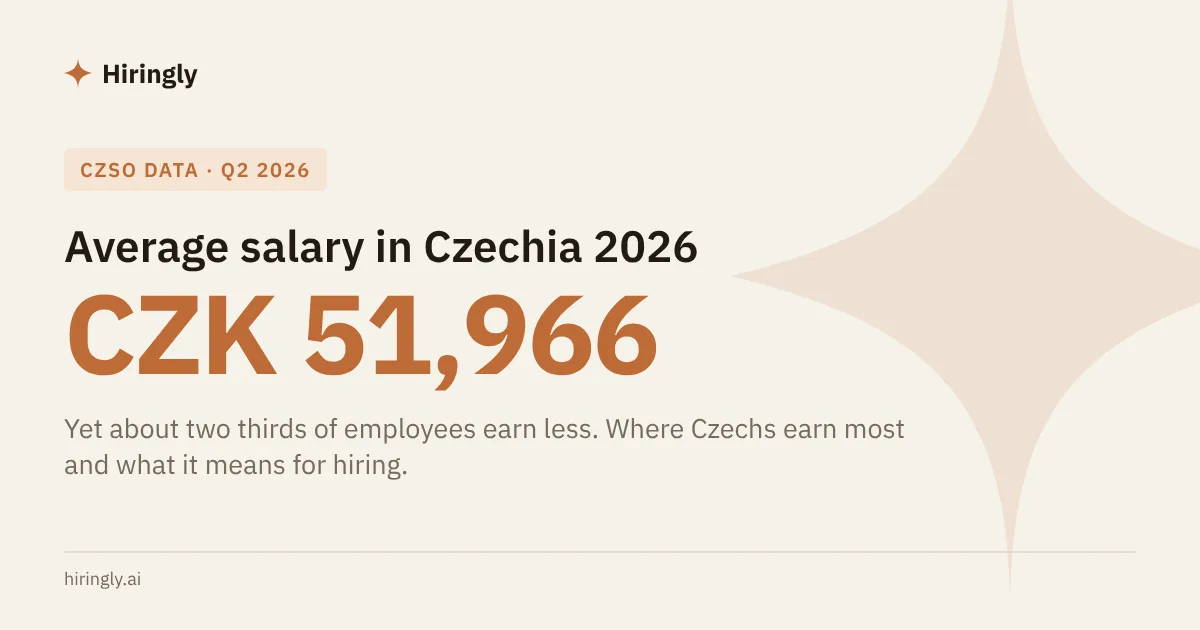
The average gross salary in the Czech Republic is now close to CZK 52,000 a month. Yet roughly two in three employees earn less than that. We went through the latest Czech Statistical Office (CZSO) data to show what people really earn, where, and what it means for employers who are hiring right now.
Key points
- The average gross monthly wage in Q2 2026 was CZK 51,966, up 6.4% year on year and 4.3% in real terms.
- The median wage for 2025 was CZK 44,337, which is CZK 7,865 below the average.
- Prague sits 27.9% above the national average, while the Karlovy Vary region is 14.4% below it.
- After tax and social contributions, the average wage is roughly CZK 40,700 net for an employee without children.
- Benchmarking a job offer against the national average is misleading. Use the median for the occupation and region instead.
The Czech average salary in 2026 at a glance
The CZSO published its Q2 2026 wage figures on 3 September. They are preliminary, and revised numbers follow in December.
- Average gross monthly wage: CZK 51,966.
- Annual increase: CZK 3,105, or 6.4%.
- Real growth: 4.3%, with consumer prices up 2.0%.
- First half of 2026: CZK 50,650, up 6.2% on a year earlier.
- Number of employees: up 0.7% year on year.
Pay grew fastest in administrative and support services (16.6%), a sector that includes staffing and security firms. Public administration and defence added 9.0%. The slowest growth came in other service activities (0.2%) and mining and quarrying (2.2%).
The next release, covering Q3 2026, is due on 4 December 2026.
Why most people earn less than the average
A small group of high earners, mainly managers and senior professionals, pulls the average up. The median is a better yardstick: it is the pay of the employee right in the middle, with half earning less and half earning more.
According to the CZSO structure of earnings survey for 2025, released in May 2026:
- Average wage 2025: CZK 52,202.
- Median wage 2025: CZK 44,337, about 15% lower.
- Median for men: CZK 47,648. Median for women: CZK 41,068.
In its Prague release, the CZSO itself notes that about two thirds of employees earn less than the average.
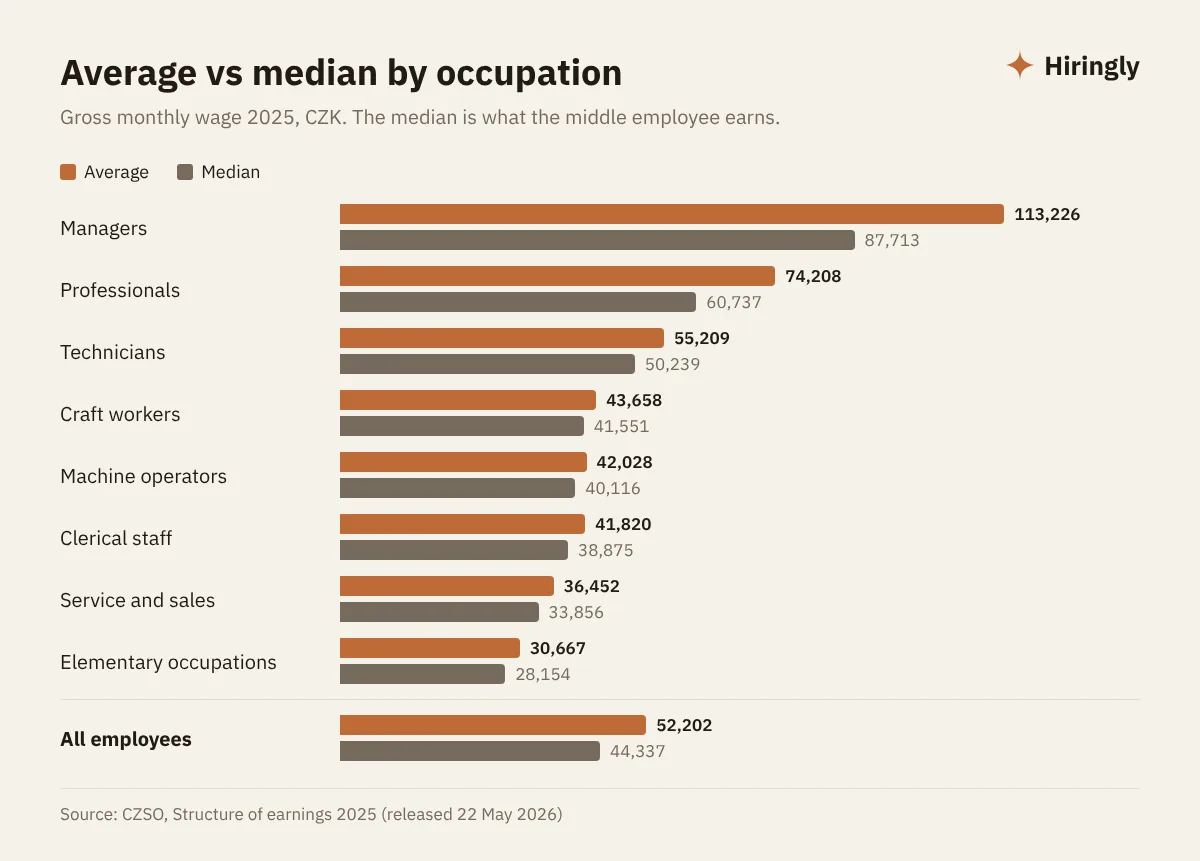
Where the gap is widest
- Managers: average CZK 113,226, median CZK 87,713. A gap of more than CZK 25,000.
- Professionals: average CZK 74,208, median CZK 60,737.
- Craft and trade workers: average CZK 43,658, median CZK 41,551. Pay is much more even here.
- Elementary occupations: average CZK 30,667, median CZK 28,154.
Note: there is no 2026 median yet. The CZSO is switching to a new employer reporting source and has temporarily stopped publishing medians and deciles for this year. The latest median is for 2025.
Average salary by region
Geography matters as much as job title. Prague, at CZK 66,459, is 27.9% above the national figure. According to the CZSO, the Karlovy Vary region, at CZK 44,476, is the only region below CZK 45,000.
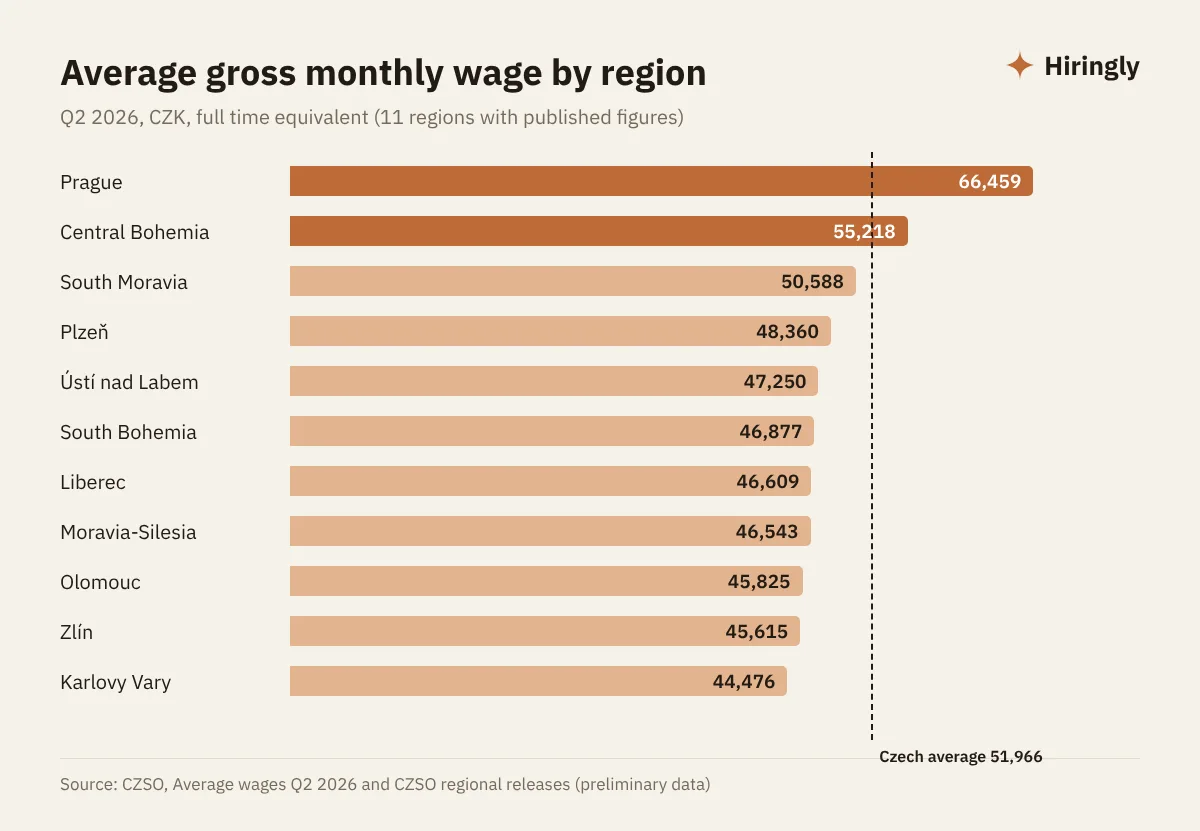
| Region | Average wage Q2 2026 | vs national average |
|---|---|---|
| Prague | CZK 66,459 | +27.9% |
| Central Bohemia | CZK 55,218 | +6.3% |
| South Moravia | CZK 50,588 | −2.7% |
| Moravia-Silesia | CZK 46,543 | −10.4% |
| Karlovy Vary | CZK 44,476 | −14.4% |
Wages are rising fastest outside the capital, though. The CZSO Moravian-Silesian release shows Moravia-Silesia up 6.8%, with South Bohemia and Plzeň up 6.7%. The Zlín region grew slowest, at 5.3%.
Prague is also where the jobs are
Prague does not just pay the most. The CZSO counts 787,300 full-time-equivalent employees there, 13,700 more than a year ago. That is 48% of all employment growth in the country.
- Employers in Prague: you compete with the largest pool of employers in the country, so speed of hiring decides.
- Employers in Central Bohemia: commuters compare your offer with Prague pay. Shorter travel time is your argument.
- Employers in other regions: lower pay levels only help if candidates do not see them as a reason to move to Prague or across the border to Germany.
What the average salary means in net pay
The figures below are for an employee with no children who has signed the standard tax declaration with their employer. We used the 2026 rates: 7.1% social security, 4.5% health insurance, 15% income tax and a CZK 2,570 monthly taxpayer credit.
| Gross wage | Tax and contributions | Net pay (approx.) |
|---|---|---|
| CZK 44,476 (Karlovy Vary) | CZK 9,265 | CZK 35,200 |
| CZK 51,966 (national average) | CZK 11,259 | CZK 40,700 |
| CZK 66,459 (Prague) | CZK 15,115 | CZK 51,300 |
Hiringly calculation, indicative only. Child tax credits and other deductions increase net pay.
What the data means for employers who are hiring
The national average is a popular anchor when setting pay. It is also misleading. It is too high for a warehouse role in Karlovy Vary and too low for a developer in Prague.
How to set the salary in a job ad
- 1Start with the occupation median, not the national average. For manual and clerical roles, the median is much closer to market reality.
- 2Adjust for the region. The gap between Prague and Karlovy Vary is over CZK 20,000 gross.
- 3Check what competitors offer. Our analysis of advertised salaries by city and field helps here.
- 4Publish a pay range. Candidates can see at once whether applying makes sense, and EU pay transparency rules will push in that direction from 2027 anyway.
- 5Factor in growth. Wages are rising about 6% a year, so last year's offer may already be below market.
- 6Watch the floor. For entry-level roles, keep an eye on the Czech minimum wage for 2027.
More applicants, less time spent screening
A competitive salary brings more applications, and with them more work. Screening hundreds of CVs can take days. An AI ATS helps: Hiringly, for example, is free for employers, ranks applicants by fit and explains why for each one. Data stays in the EU, and a person always makes the decision on who gets an interview.
What the data means for job seekers
- Don't compare yourself with the average. Compare yourself with the median for your occupation and region.
- Track real growth. If your pay has not risen at least in line with inflation (2.0%) over the past year, you are worse off in real terms.
- Bring data to the table. CZSO figures are solid evidence in a pay rise conversation.
- Compare offers. You can browse current openings with salaries on the Hiringly job board.
FAQ
What is the average salary in the Czech Republic in 2026?
In Q2 2026 the average gross monthly wage was CZK 51,966. For the first half of 2026 it was CZK 50,650. The source is the CZSO.
What is the median salary in the Czech Republic?
The latest median is for 2025: CZK 44,337 gross a month. The CZSO is not publishing a 2026 median for now while it moves to a new data source.
How much is the average salary after tax?
For an employee without children who has signed the tax declaration, a gross wage of CZK 51,966 comes to roughly CZK 40,700 net. Child tax credits raise that figure.
Which Czech region has the highest and lowest wages?
Prague has the highest average wage (CZK 66,459), followed by Central Bohemia (CZK 55,218). The Karlovy Vary region has the lowest (CZK 44,476).
When will new wage data be released?
The CZSO will publish Q2 revisions and the first Q3 2026 figures on 4 December 2026.
AI recommends, a human decides.
Hiringly shows the reasoning for every candidate, stores data in the EU and never rejects anyone automatically.