Guide
Work from home jobs in Czechia: 7 steps to find one safely
Work from home jobs in Czechia: which sectors offer remote work, how to land a role, the CZK 4.70/h allowance in 2026 and 8 red flags of job scams.
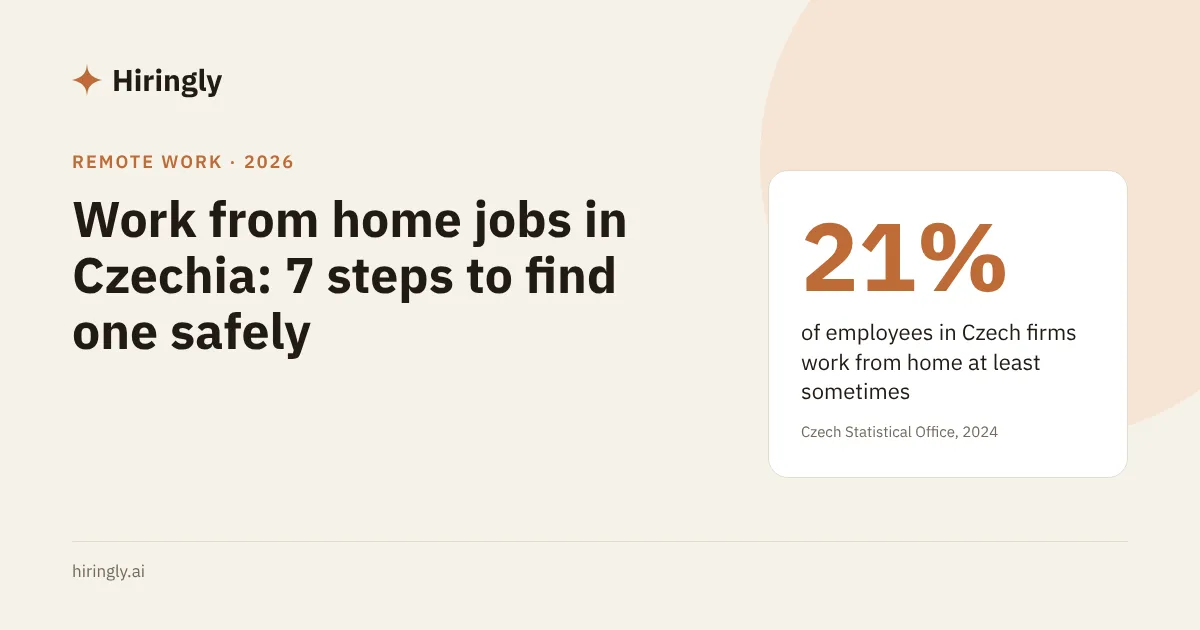
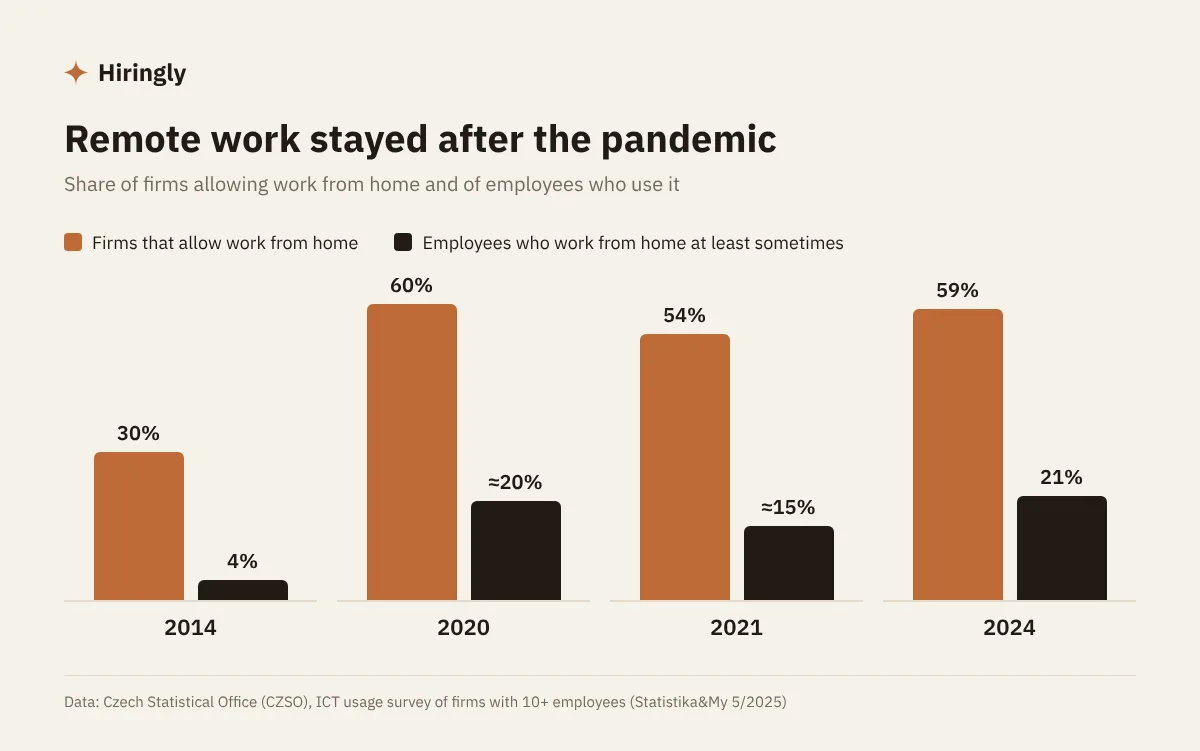
Remote work did not disappear after the pandemic. According to the Czech Statistical Office, 59% of Czech firms now allow it and one in five of their employees works from home at least sometimes. But every good remote offer attracts a crowd of applicants, and scammers hide among the listings. Here is how to land a real work from home job in Czechia without getting burned.
Key points
- 59% of Czech firms allow working from home and 21% of their employees use it at least sometimes (CZSO, 2024).
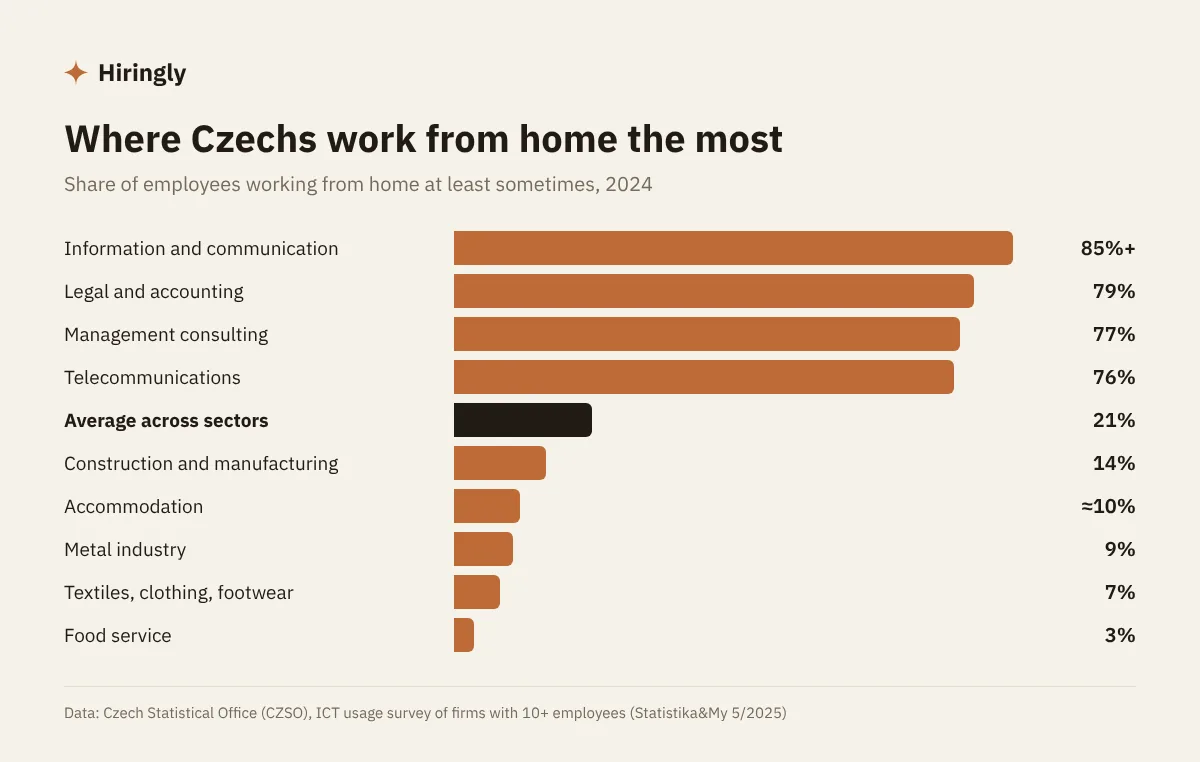
- Your odds depend on the sector: over 85% of people in IT work from home, in food service only 3%.
- Fully remote roles are rare and fiercely contested. A hybrid role with 2 or 3 days at home is the realistic target.
- In 2026 the flat-rate home office allowance is CZK 4.70 per hour, if you agree on it with your employer.
- "Easy money for forwarding payments" is not a remote job. It is money laundering and can lead to criminal charges.
How many people in Czechia work from home
The numbers depend on who measures and how. Both main sources point the same way, though: remote work is here to stay.
- CZSO (firms with 10+ employees): in 2024, 59% of firms allowed work from home, up from 30% in 2014.
- Employees of those firms: 21% work from home at least sometimes. Ten years ago it was 4%.
- IDEA think tank at CERGE-EI: a 2025 study finds that roughly one in ten employees across the whole economy works from home, most of them for less than half their hours.
For context, 8.8% of employed people in the EU usually worked from home in 2025, according to Eurostat. Czechia sits close to the middle of the pack.
Demand beats supply
The same IDEA study shows that 66% of men and 70% of women would like to work from home several days a week, most often two or three. Mothers of children under two use it the most: almost a third of them.
Far more people want remote work than there are remote jobs. That gap is what makes the search hard.
Where your chances are highest
The sector matters more than the job title. The gap between industries is huge.
Sectors with the most remote work
| Sector | Employees working from home | Typical roles |
|---|---|---|
| IT and communication | over 85% | developer, tester, IT support, data analyst |
| Legal and accounting | 79% | accountant, payroll specialist, paralegal |
| Management consulting | 77% | consultant, project manager |
| Telecommunications | 76% | customer support, sales, technician |
| Food service | 3% | almost no remote work |
Data: Czech Statistical Office, 2024.
IDEA also finds that remote work is almost exclusively for people with at least a secondary school leaving exam. About a quarter of university graduates work from home.
Note: if you work in manufacturing, retail or hospitality, a fully remote job is unlikely. The realistic move is an office role in the same industry (planning, purchasing, customer support), where hybrid work is already common.
Why remote jobs are so competitive
LinkedIn data for Europe, the Middle East and Africa show that 15.4% of all applications go to fully remote roles, even though such roles are much scarcer. In Ireland, for example, they made up 9.1% of job posts but drew 20.1% of applications.
In practice this means:
- a remote role often gets several times more CVs than an office one,
- recruiters screen fast, so a generic CV rarely makes it,
- fully remote roles are often open to candidates from other countries, so you compete with all of Europe.
How to find a work from home job: 7 steps
- 1Look for hybrid, not only 100% remote. Hybrid roles are far more common: in Ireland they made up 37% of LinkedIn job posts, fully remote only 9.1%.
- 2Use the right filters. On Czech job portals, search for "práce z domova", "home office", "hybridní" and "práce na dálku", plus "remote" in English listings.
- 3Target sectors with high remote shares. IT, accounting, consulting and customer support are the safest bets (see the table above).
- 4Tailor your CV for every application. Mention remote work experience, tools (Teams, Slack, Jira) and measurable results. Our guide to an ATS-friendly CV shows how to pass automated screening.
- 5Prove you can work on your own. In your cover letter, give one concrete example of a project you delivered without supervision.
- 6Check the pay. Remote does not have to mean lower pay. See what Czech employers offer by city and field in our advertised salaries analysis.
- 7Get the terms in writing. Czech law requires a written remote work agreement. Make sure it states your days at home and any cost allowance.
You can also browse current openings, including hybrid ones, on the Hiringly job board.
What you are entitled to: the 2026 allowance
Remote work is governed by the Czech Labour Code. According to a summary in Advokátní deník, these are the key rules for 2026:
- written agreement: remote work must be agreed in writing, separately or in the employment contract or a DPP/DPČ agreement,
- CZK 4.70 per hour: set by Ministry of Labour decree No. 572/2025 (CZK 4.50 in 2025), paid only if you agree on it,
- tax free: the allowance is not taxed and covers energy, heating, water and waste,
- internal rules in the private sector may set a higher flat rate,
- ending it: either side can end the arrangement with 15 days' written notice.
What it means in money
With three days at home per week, you work about 13 days a month remotely. That is 104 hours, or roughly CZK 489 a month extra (104 × CZK 4.70). Fully remote (about 21 working days) brings around CZK 790 a month.
How to spot a work from home scam
In early November 2026 the Czech Police issued another warning about "easy money" offers. Fraudsters recruit people to receive other people's money on their bank accounts and pass it on or buy crypto with it. These money mules can end up as criminal suspects themselves.
Checklist: 8 red flags
- High pay for little work and no experience required.
- The job is "payment processing" or "help with foreign transfers".
- Money from strangers lands in your account and you must forward it.
- Pressure to decide fast, or a request to keep things secret.
- They ask for your online banking login, card or authorisation codes.
- Contact only via WhatsApp or Telegram, no interview or video call.
- The company is not in the commercial register, or its website is weeks old.
- You must pay upfront for training, materials or "registration".
If you have already received or forwarded money, the police advise stopping all transfers, contacting your bank and the police, and keeping all messages, the ad and the account numbers.
A tip for employers: remote ads bring hundreds of replies
Offering remote work means more CVs and more screening. A clear job ad with the number of home office days and the salary helps. See how to write a job ad.
For the first pass you can use Hiringly, a free AI ATS. It ranks applicants by fit and explains why for each one. Data stays in the EU and a person always makes the call.
FAQ
How many people work from home in Czechia?
The Czech Statistical Office reports that 21% of employees in firms with 10+ staff work from home at least sometimes (2024). The IDEA study, covering the whole economy, puts it at about one in ten employees.
Does a Czech employer have to pay a home office allowance?
Only if you agree on it. In 2026 the flat rate is CZK 4.70 per hour worked at home, and it is tax free.
Which remote jobs suit beginners without experience?
Customer support, administration, transcription and basic bookkeeping are the usual entry points. Be careful, though: "no experience, high pay" is a classic sign of a scam.
Can I work from home on a DPP or DPČ agreement?
Yes. Remote work can be agreed for these agreements too, always in writing.
How can I tell a remote job offer is a scam?
The biggest warning sign is handling other people's money through your account, along with high pay for nothing and pressure to act fast. Check the company in the commercial register and never share your banking access.
AI recommends, a human decides.
Hiringly shows the reasoning for every candidate, stores data in the EU and never rejects anyone automatically.