Guide
Hiring seasonal workers: 8 steps to fill shifts in 7 days
Hiring seasonal and shift workers in Czechia: job ads, fast screening, 2026 DPP and DPČ limits, premiums and a 7-day plan to fill shifts.
The holiday peak is about to hit shops, warehouses and restaurants. Many Czech employers start looking for temporary staff in the last few weeks, only to find that the best candidates already accepted another offer the day before. This guide shows how to fill your shifts within seven days without losing people or paying fines.
Key points
- Czechia has 3.5 registered jobseekers per vacancy. In Prague it is only about 1.6, so employers compete for every temp.
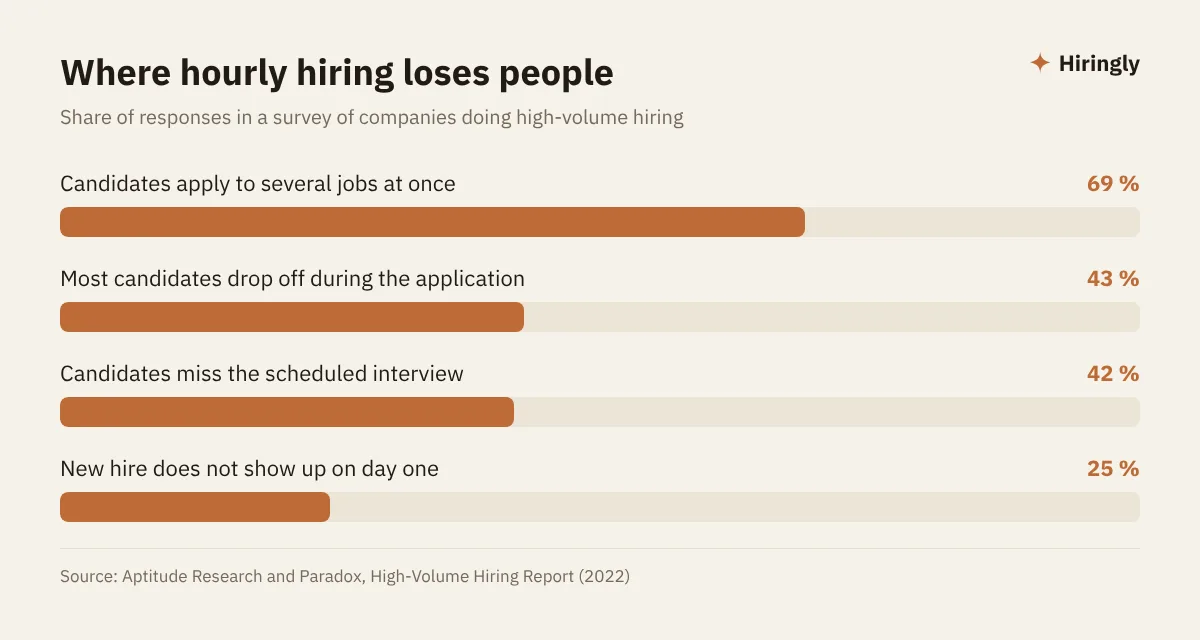
- Speed wins: 69% of hourly candidates apply to several jobs at once.
- The application must take a few minutes on a phone, or people drop out before you ever speak to them.
- In 2026, a DPP agreement is capped at 300 hours a year, with insurance due from CZK 12,000 a month. For a DPČ it is CZK 4,500.
- Since July 2026, temporary workers must be registered with the social security office before their first shift.
Why hiring seasonal workers is harder this year
The Czech labour market is still tight. At the end of October 2026, the Labour Office reported 370,226 jobseekers and 106,252 vacancies, with an unemployment share of 5.0% (Práce a mzda, citing the Labour Office). That is 3.5 jobseekers per vacancy on average.
Big cities are tighter still. Prague had 24,476 vacancies and 39,568 jobseekers, with an unemployment share of 3.92% (Czech Statistical Office).
| October 2026 | Czechia | Prague |
|---|---|---|
| Unemployment share | 5.0% | 3.92% |
| Vacancies | 106,252 | 24,476 |
| Jobseekers per vacancy | 3.5 | about 1.6 |
For seasonal roles the lesson is simple. Whoever replies first gets the people. If applications sit in an inbox until Monday, you hire from whoever is left.
Where hourly hiring loses candidates
High-volume hiring has predictable weak spots. A survey by Aptitude Research and Paradox among companies hiring hourly workers at scale spells them out (High-Volume Hiring Report):
- 43% of companies lose the most candidates during the application itself,
- 42% struggle with candidates who miss scheduled interviews,
- 25% see new hires fail to show up on day one,
- 1 in 2 has no mobile-friendly application.
The good news is that each of these leaks can be fixed with process, not budget.
8 steps to fill shifts in 7 days
1. Count shifts, not heads
Before writing the ad, map the actual demand: how many shifts, which days and hours, and for how long. Headcount follows from that.
- Plan for 20 to 30% extra people. Some will not start, others will leave after the first week.
- Split shifts into a fixed core and a flexible pool. Offer the flexible shifts to students and people with a main job.
2. Write an ad that answers three questions
Temporary workers decide in seconds. Put these in the first lines:
- 1What do I earn: a real hourly rate, not "negotiable".
- 2When and where: days, shift times and the address or district.
- 3How fast can I start: for example "start within 3 days after a short call".
For more on structure, see our guide on how to write a job ad.
3. Cut the application to two minutes
A seasonal role does not need a cover letter. Ask for a name, phone number, availability and one or two must-have questions (weekend work, or a food handler certificate in hospitality).
Note: do not ask about age, family status or health beyond what the job legally requires. None of it belongs in the selection.
4. Reply within 24 hours
In the same survey, 62% of companies said speed to interview is the most critical step, because candidates go quiet or accept another job in the meantime. Set a simple rule: every application gets a reply by the next day.
5. Interview by phone, decide on the call
A 10-minute call is enough for most shift roles. Check availability, relevant experience and how the person will get to work. If it fits, offer the first shift during the same call.
6. Get DPP and DPČ right from day one
Most seasonal work in Czechia runs on two types of agreements. The key 2026 limits:
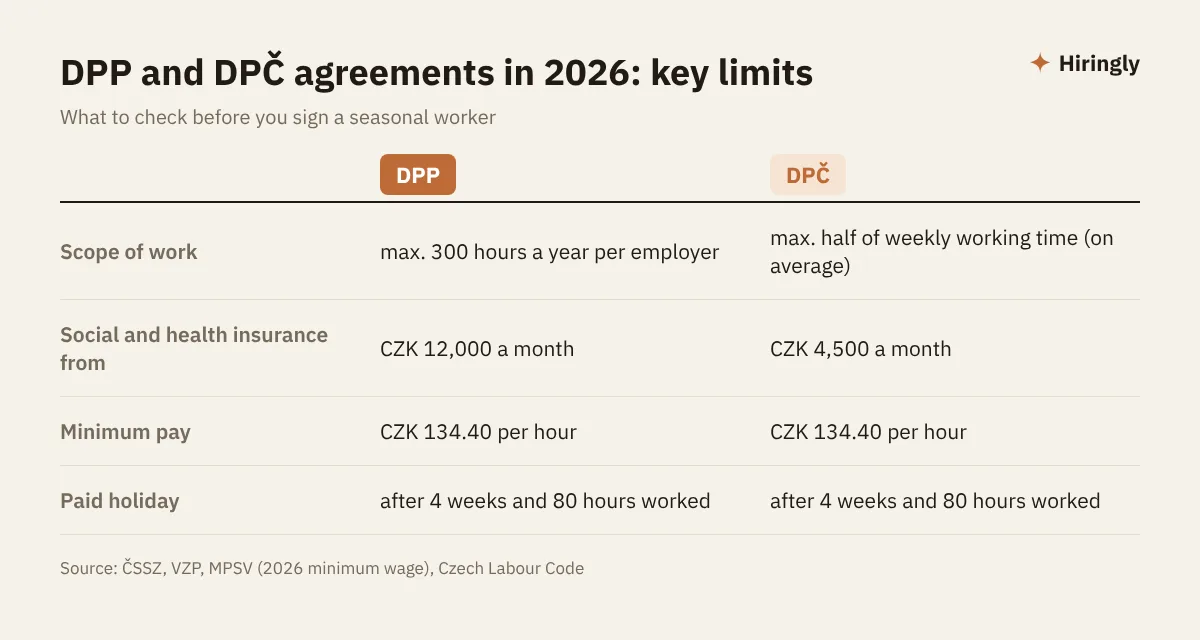
- DPČ: insurance from CZK 4,500 a month, and work limited to half of the standard weekly hours.
- Minimum pay: CZK 134.40 per hour, with the monthly minimum wage at CZK 22,400 (MPSV). It rises to CZK 24,900 in January 2027, as covered in our article on the Czech minimum wage 2027.
- Paid holiday: applies once the agreement has lasted 4 weeks and the person has worked at least 80 hours (ARROWS).
Since April 2026, every agreement goes into the new unified monthly report (JMHZ), even below the insurance threshold. Since July 2026, workers must be registered before they start rather than within 8 days. Mistakes can cost up to CZK 50,000 per breach (ARROWS).
7. Budget for premiums
Workers on agreements are entitled to a weekend premium of at least 10% of average hourly earnings. Public holidays mean time off in lieu, or by agreement a premium of at least 100% (Prace.cz).
Christmas and New Year's Eve are exactly when employers forget this. Put it in the budget up front.
8. Make the first shift worth coming back for
One in four companies sees new hires skip day one. What helps:
- a text message the day before with the address, start time and the name of the person who will meet them,
- a 15-minute briefing at the start of the shift,
- a buddy for the first shift,
- a quick check-in call after it.
For the longer version, see our 90-day employee onboarding checklist.
A 7-day plan from job ad to first shift
| Day | What to do | Outcome |
|---|---|---|
| 1 | Map shifts, publish the ad | Ad is live |
| 2 to 3 | Review applications daily, call | Shortlist |
| 3 to 4 | Offer by phone, sign agreements | Confirmed hires |
| 5 | Register workers, send instructions | Ready to start |
| 6 to 7 | First shifts with a briefing | Shifts filled |
Days 2 and 3 are where most time disappears, when hundreds of applications arrive at once. Reviewing them by hand is slow and tiring. This is where an AI ATS helps: Hiringly is free, ranks applicants by fit and explains why for each one. Data stays in the EU, and a person always makes the call.
For more ways to move faster, read how to reduce time to hire.
Seasonal hiring checklist
- Number of shifts plus a 20 to 30% buffer
- Ad with hourly rate, shift times and location
- Mobile application that takes under 2 minutes
- A reply to every applicant within 24 hours
- Phone interview with an offer on the call
- The right agreement type, tracking the 300-hour and CZK 12,000 limits
- Registration before the first shift
- Weekend and holiday premiums in the budget
- A text the day before and a buddy on site
Looking for a job yourself? Browse current openings on the Hiringly job board.
FAQ
How many hours can someone work on a DPP?
Up to 300 hours per calendar year with one employer. Hours from all DPP agreements with the same employer are added together. If you need more, use a DPČ or a regular employment contract.
When does a DPP become subject to insurance in 2026?
From CZK 12,000 gross per month with a single employer. Once earnings reach that level, social and health insurance apply to the full amount.
Do workers on agreements get paid holiday?
Yes, if the agreement lasts at least 4 weeks and they work at least 80 hours for the same employer in a calendar year. Unused holiday must be paid out when the agreement ends.
How quickly should I reply to seasonal applicants?
Ideally within 24 hours. Hourly candidates usually apply to several jobs and take the first reasonable offer.
Can AI decide who gets hired?
No. AI can rank applications and explain the ranking. Inviting and hiring is always a human decision.
AI recommends, a human decides.
Hiringly shows the reasoning for every candidate, stores data in the EU and never rejects anyone automatically.