Guide
Future skills 2030: 8 skills employers want in the AI era
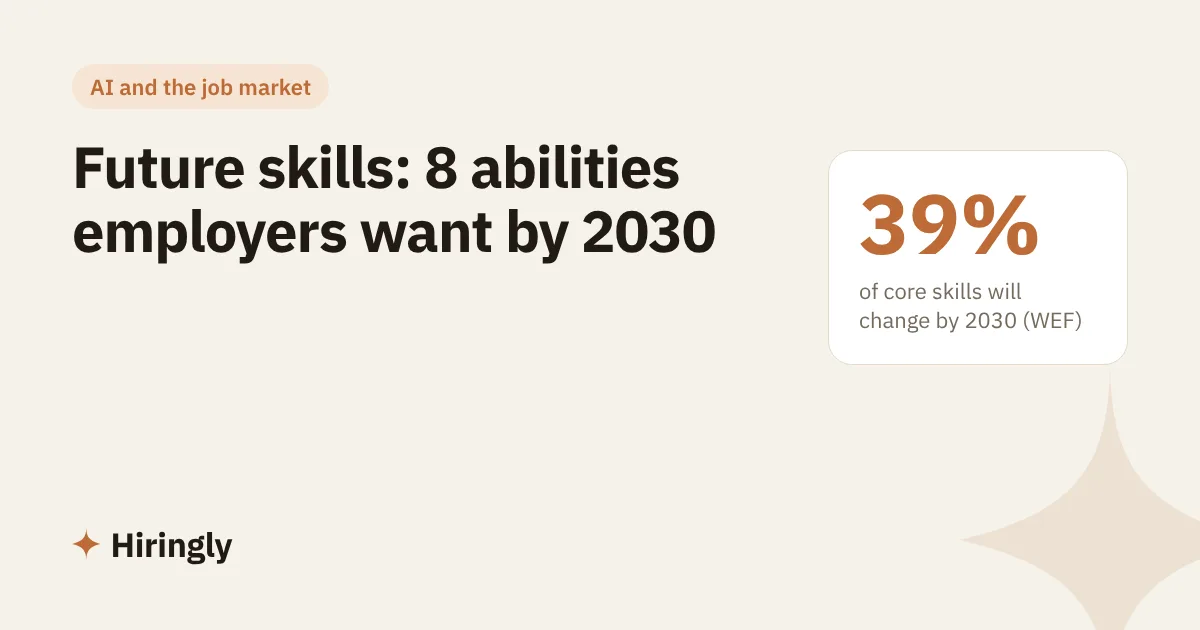
39% of core skills will change by 2030. The 8 future skills employers want, fresh Czech data and checklists for job seekers and HR teams.
Roughly two in five of the skills employers rely on today will look different by 2030. That is not the end of work. It is the end of assuming that what you know now will carry you through the decade. Here are the eight skills employers are betting on, and what they mean for people working and hiring in Czechia.
Key points
- The World Economic Forum expects 39% of core skills to change by 2030, and 59 of every 100 workers to need training.
- Demand is growing fastest for AI and big data, networks and cybersecurity, and technological literacy.
- Human skills still matter: analytical thinking, creative thinking, resilience and curiosity rank among the most wanted.
- 35% of Czech companies with 10 or more employees now use AI, up from 18% a year earlier.
- Hiring for skills rather than degrees widens the pool of suitable candidates.
Why future skills matter right now
This is not conference talk. The World Economic Forum's Future of Jobs Report 2025 expects about 170 million jobs to be created worldwide by 2030 and about 92 million to disappear.
That is a net gain of 78 million jobs. The catch: the new jobs ask for different skills than the ones that are fading.
- 39% of core skills will change by 2030, according to the WEF.
- 70% of the skills used in most jobs will change by 2030, according to the LinkedIn Work Change Report.
- 63% of employers say skill gaps are the biggest barrier to transforming their business (WEF).
Czechia: AI adoption is moving faster than expected
In November 2026 the Czech Statistical Office (ČSÚ) reported that 35% of companies with 10 or more employees use AI tools. Among large companies it is almost three in four.
In 2025 the figure was 18%, according to an earlier ČSÚ release. The share roughly doubled in a single year.
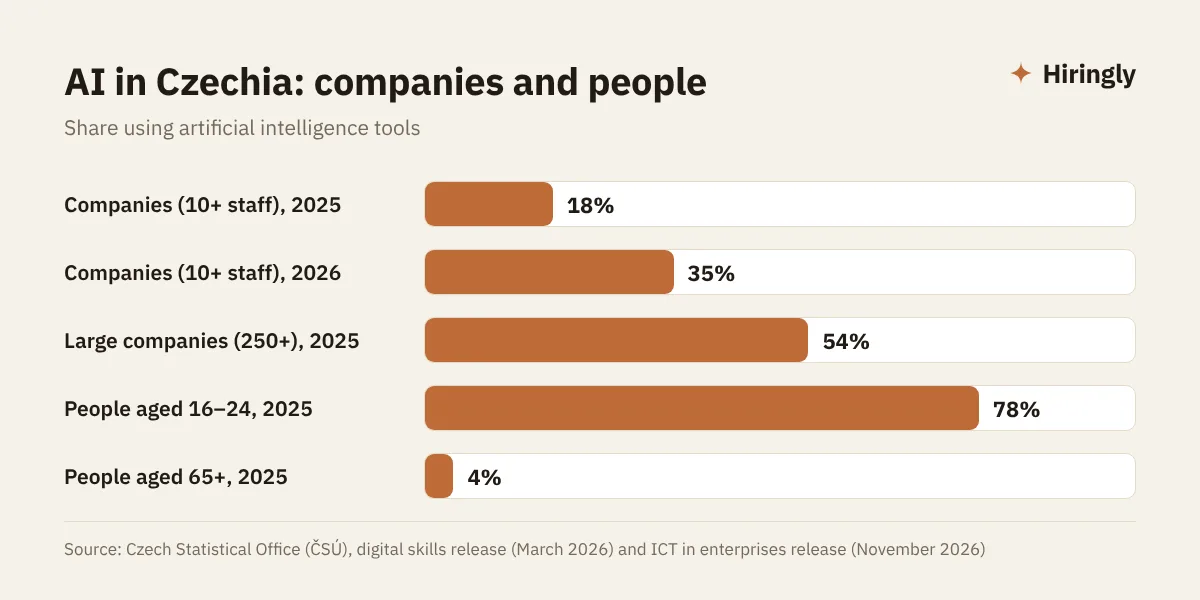
The good news is that the foundation is there. 70% of Czechs aged 16 to 74 have at least basic digital skills, against an EU average of 60% (ČSÚ). The gap is generational: 78% of people aged 16 to 24 use AI, compared with just 4% of those over 65.
8 future skills employers want
The list is based on the skills outlook chapter of the WEF report. For each skill we add what it looks like on the job.
1. AI and big data
The fastest-growing skill to 2030, according to the WEF. And it is not just for developers.
- An accountant who lets AI pre-sort invoices and only checks the exceptions.
- A salesperson who pulls CRM data to spot which customers are about to churn.
- A production supervisor who can read sensor data from the line.
It pays. PwC's 2025 Global AI Jobs Barometer found that roles requiring AI skills carried an average 56% wage premium in 2024.
2. Networks and cybersecurity
The second fastest-growing area. Every new AI tool brings new risks: phishing, data leaks, fake invoices.
You do not need to be a security specialist. You do need to spot a fraudulent email and know which data never goes into a public AI tool.
3. Technological literacy
Third on the growth list. It means picking up new software quickly and without fear.
On the job, it is the colleague who gets comfortable with a new system in a week instead of waiting three months for formal training.
4. Analytical thinking
Seven in ten companies call it a core skill, which keeps it at the top of the list.
AI can generate an answer. A person still has to judge whether it is right and decide what to do with it.
5. Creative thinking
When AI handles the routine, ideas become more valuable. Creativity at work means finding a better process, a new product or a smarter way to reach customers.
6. Resilience, flexibility and agility
The share of employers calling this a core skill rose by 17 percentage points since 2023, according to the WEF. People will switch roles more often.
LinkedIn estimates that people entering the workforce today will hold about twice as many jobs over their careers as those who started 15 years ago.
7. Curiosity and lifelong learning
When skills change this fast, the ability to learn becomes the most valuable one. Employers increasingly weigh it above specific degrees.
PwC reports that the share of AI-augmented jobs requiring a university degree fell from 66% to 59% between 2019 and 2024.
8. Leadership and social influence
The biggest climber: 22 percentage points more employers now rank it as core than in 2023 (WEF). Teams will work alongside AI, and someone has to lead them through the change.
Cheat sheet: how to prove each skill
| Skill | Why it is growing | How to show it |
|---|---|---|
| AI and big data | fastest growing to 2030 | a specific tool and result (hours saved) |
| Cybersecurity | more data, more risk | training completed, rules you introduced |
| Technological literacy | new systems every year | systems you learned and how fast |
| Analytical thinking | 7 in 10 employers want it | a decision backed by numbers |
| Creative thinking | AI takes over routine | a process improvement you delivered |
| Resilience and flexibility | more frequent role changes | a change you handled and what you learned |
| Lifelong learning | skills age quickly | courses and certificates from the last 2 years |
| Leadership | teams work with AI | people you onboarded or led, and the outcome |
For wording that works in a CV, see ATS-friendly CV: 10 rules.
How many people will need to reskill
The WEF frames it as a workforce of 100 people. By 2030, 59 will need some training. Some will upskill in their current role, some will move to another role, and 11, employers say, are unlikely to get the training they need.
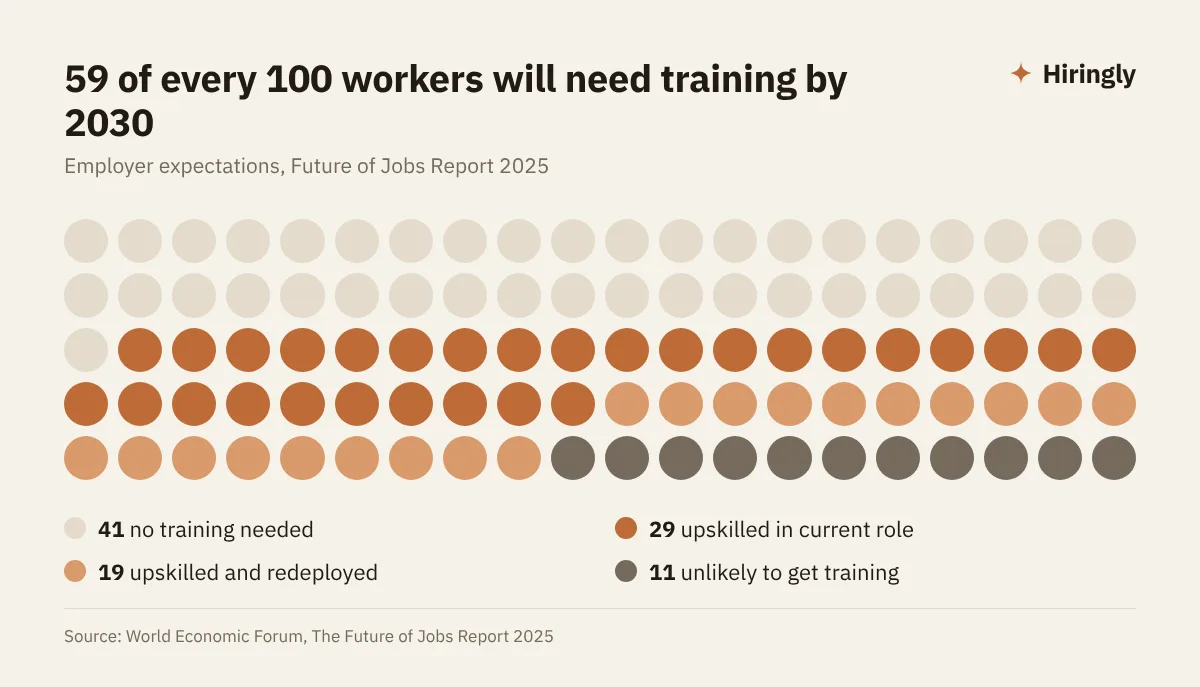
Employers are planning for it. According to the WEF, 85% intend to prioritise upskilling, and two thirds plan to hire people with specific AI skills.
For the roles changing most, read Jobs AI will replace: 7 declining and 7 growing roles.
Checklist for employers: hire for skills
If requirements in your roles keep shifting, degrees and years of experience are no longer enough. Five steps:
- 1Rewrite the job ad. Instead of "degree plus 5 years of experience", describe the work and the 3 to 5 skills it needs. Our guide on how to write a job ad walks through it.
- 2Split must-haves from nice-to-haves. The ability to learn a new system often beats experience with one specific tool.
- 3Score every applicant against the same criteria. Otherwise the nicest-looking CV wins.
- 4Ask for examples. "When did you last learn a new tool, and how long did it take?" tells you more than "what are your strengths?"
- 5Budget for onboarding. Training costs less than months with an empty seat.
When one ad attracts hundreds of applications, reading them all for skills takes days. Hiringly is a free AI ATS that ranks applicants by fit and explains why for each one. Data stays in the EU, and a person always makes the call on who gets an interview.
Checklist for job seekers: what to do this year
- Try one AI tool on a real work task and measure the time it saves.
- Add results to your CV, not just duties. Numbers work for people and for automated screening.
- Take a short course in cybersecurity or data basics. Many are free.
- Prepare a story about a change you handled well. A flexibility question is almost certain in interviews.
- Watch what job ads ask for in your field. Browse current openings on the Hiringly job board.
FAQ
What skills will be most in demand by 2030?
According to the WEF, demand is growing fastest for AI and big data, networks and cybersecurity, and technological literacy. Analytical thinking remains the most widely required skill, named as core by seven in ten employers.
Will AI replace human skills?
No. The WEF expects creative thinking, resilience, curiosity and leadership to grow in importance. AI takes over routine tasks, while judgement and working with people stay human.
Do I need to learn to code to stay employable?
No. Most employers need people who can use AI tools in their own profession, not build them. Knowing when AI helps and how to check its output is enough for most roles.
How do I show future skills on my CV?
Be specific: which tool you used, for what task and with what result. For example, "used AI to cut monthly report preparation from 2 days to half a day".
Do AI skills pay off financially?
PwC data suggests they do: roles requiring AI skills paid an average 56% premium in 2024. That is a global average, and the gap varies by field and country, including Czechia.
AI recommends, a human decides.
Hiringly shows the reasoning for every candidate, stores data in the EU and never rejects anyone automatically.