Guide
How to write a cover letter: template and 53% more interviews
How to write a cover letter recruiters read to the end: a copy-ready template, 4-paragraph structure, 7 mistakes and data on extra interviews.
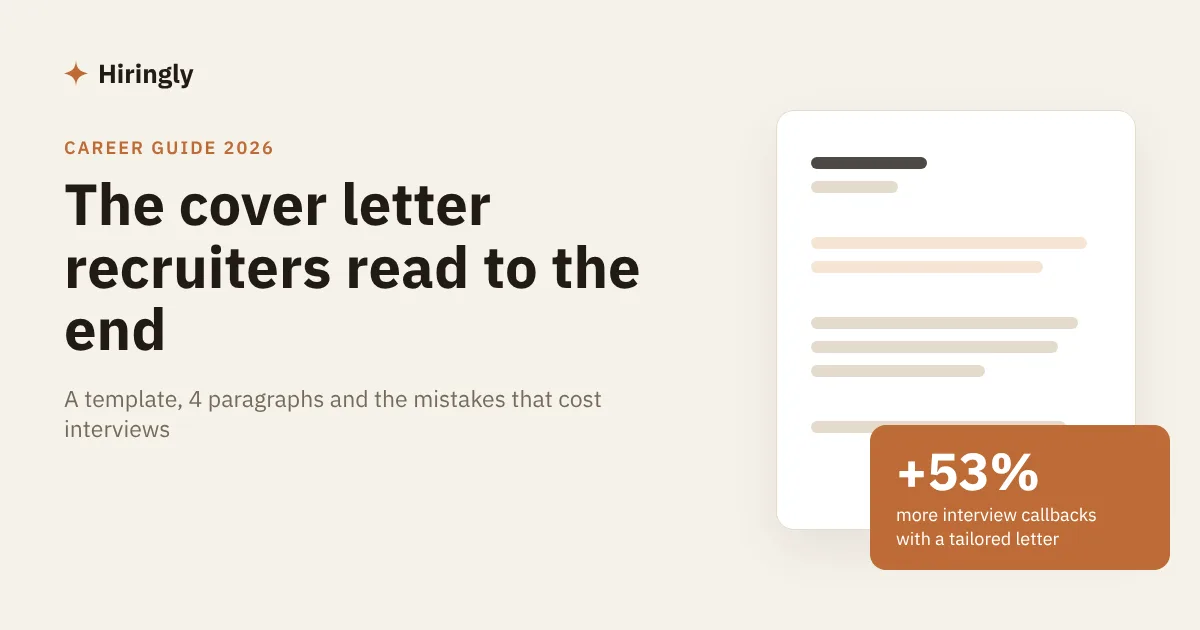
Most applicants send their CV with a single line: "Hello, please find my CV attached." Yet in a large field experiment, a cover letter tailored to the specific role brought 53% more interview callbacks. Here is how to write one in 30 minutes, plus a template you can adapt right away.
Key points
- According to ResumeGo, 87% of hiring professionals read cover letters, and tailored letters lifted callbacks by 53%.
- Keep it to two thirds of a page at most: 3 or 4 short paragraphs (roughly 250 to 400 words).
- The opening matters most: 41% of hiring managers call it the most important part of the letter.
- Write more about the employer's needs than about yourself, and back every claim with a number or an example.
- AI can help with wording, but recruiters spot a generic one-click letter instantly.
Do recruiters still read cover letters in 2026?
Short answer: yes, and more than most candidates think. The data comes mainly from the US, but the principles hold in Czechia and across Europe too.
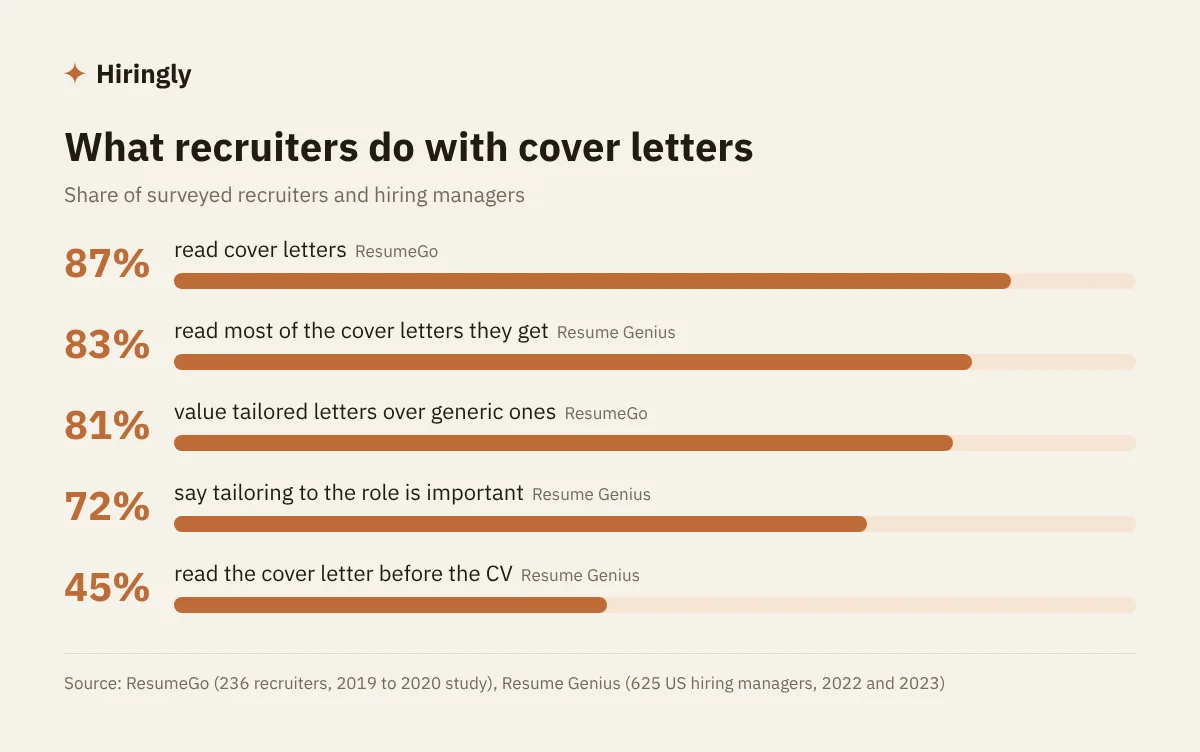
- 87% of hiring professionals read cover letters, and 81% value tailored letters over generic ones (ResumeGo, 236 recruiters).
- In the same research, ResumeGo sent 7,287 fictitious applications. Those with a tailored letter had a 53% higher callback rate than those with no letter.
- 83% of hiring managers read most of the cover letters they receive, and 45% read the letter before the CV (Resume Genius, 625 hiring managers).
- 88% of job seekers believe a cover letter improves their chances, yet only 65% regularly send one (MyPerfectResume, 1,000 job seekers, 2025).
When a cover letter is a must
Jobs.cz, the largest Czech job board, recommends attaching a letter whenever the ad asks for one. That is most common for senior roles, but also for graduates without a long track record (Jobs.cz Poradna, 2026).
A letter also pays off when:
- you are switching fields and your CV alone does not explain why you apply,
- you have a career gap or an unusual move,
- you approach a company with no open role,
- dozens of people with similar experience apply for the same job.
Cover letter structure: 4 paragraphs
Czech HR specialist Tereza Valášková advises in the Jobs.cz advice section to keep it to 3 or 4 paragraphs and, above all, to write "less about yourself". Experienced recruiters use the same skeleton.
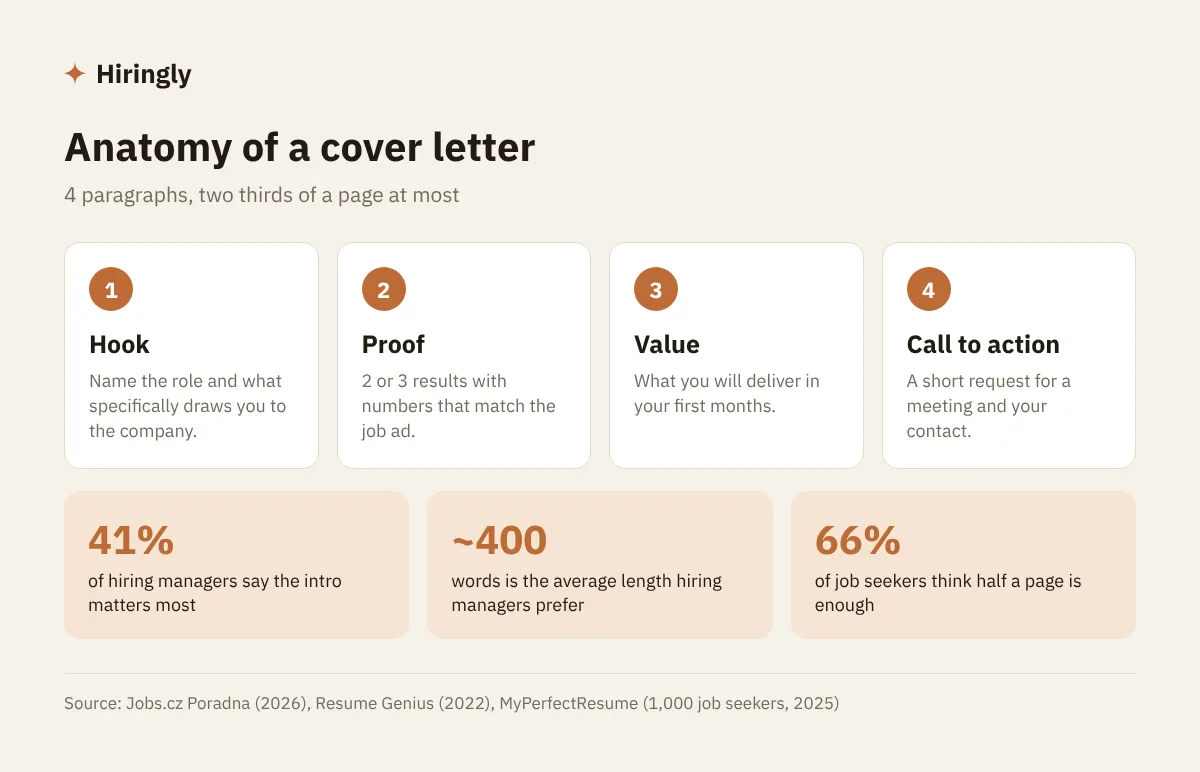
| Paragraph | What goes in | Length |
|---|---|---|
| 1. Hook | The role and one specific thing that drew you to the company | 2 to 3 sentences |
| 2. Proof | 2 or 3 results with numbers that match the job ad | 3 to 5 sentences |
| 3. Value | What you will deliver in your first months | 2 to 3 sentences |
| 4. Call to action | A request for a meeting, phone and email | 1 to 2 sentences |
The opening decides
Resume Genius found that 41% of hiring managers see the introduction as the most important part of the letter. No other section comes close.
So skip "I am writing to apply for the position of…". Open with what you know about the company and why it connects to you.
How long should a cover letter be
- Jobs.cz recommends two thirds of a page at most.
- Hiring managers surveyed by Resume Genius prefer around 400 words on average.
- 66% of job seekers think half a page or less is enough (MyPerfectResume).
In practice, 250 to 350 words works best. On a phone, where recruiters now read many applications, that is two or three screens.
Cover letter template
The template below is for a customer support role at an online store. Replace the brackets with your own details.
"Dear Ms Novotná,
I am responding to your opening for a Customer Support Specialist. Your ad mentions a goal of answering customers within two hours, which is exactly what I have worked on for the past [18 months] at [Company X].
In a team of [5], I handled email and chat support. We cut average response time from [6 hours to 90 minutes] and customer satisfaction rose to [4.7 out of 5]. I also wrote [40 reply templates] the team still uses.
In my first months with you, I would map the most frequent questions and turn them into help articles so customers can find answers on their own.
I would be glad to tell you more in a short call. You can reach me at [+420 777 123 456] or [name@email.com].
Kind regards, [First Last]"
Why this template works
- A specific hook: it quotes a detail from the ad, so it is clearly not a mass mailing.
- Numbers, not adjectives: instead of "diligent and communicative", it shows results.
- Value for the employer: the third paragraph is about what the company gains.
- A clear close: the recruiter knows exactly what to do next.
7 mistakes that cost you the interview
- 1A generic opening line. Jobs.cz lists "I believe I am the ideal candidate" among phrases to avoid.
- 2Repeating your CV. Pick your 2 or 3 strongest points instead of retelling everything.
- 3"Dear Sir or Madam". The recruiter's name is often in the ad or on LinkedIn.
- 4One letter for every company. Recruiters notice, and 81% prefer a tailored letter.
- 5More than one page. Long text does not get finished on a phone.
- 6A letter written only by AI. MyPerfectResume found 32% of job seekers used AI on their letters. A generic output without your numbers and examples reads as empty.
- 7The wrong format. Send the letter as a PDF with your CV and add a short note in the email body.
Note: leave out your age, marital status and health. An employer does not need them to decide.
How AI and ATS software read your letter
Many companies now sort applications in an applicant tracking system. Modern AI tools read both the CV and the cover letter and compare them with the role's requirements.
What that means for you:
- Mirror the ad's wording. If the company asks for "Excel and SAP experience", use those exact words.
- Be concrete. Both software and people value "led a team of 6" over "have management experience".
- No text inside images. A letter saved as an image or scan may not be readable.
Hiringly, for example, is a free AI ATS for companies in Czechia and the EU. It ranks applicants by fit and explains why for each one, keeps data in the EU, and leaves every decision to a person. A well written letter therefore helps twice: in automated sorting and when a recruiter reads it. For the CV itself, see ATS-friendly CV: 10 rules to get past AI screening.
Checklist before you hit send
- I address a specific person by name.
- The first sentence names the role and one concrete detail about the company.
- The letter includes at least 2 results with numbers.
- I used 3 to 5 keywords from the job ad.
- It fits on two thirds of a page.
- It ends with a request for a meeting and my contact details.
- The file is a PDF named "First-Last-cover-letter.pdf".
- Someone else read it, or I read it out loud.
Looking for where to send it? Browse current openings on the Hiringly job board. If you want remote work, read 7 steps to find a work from home job safely. And if a company says no, see what a good rejection looks like from the employer's side.
FAQ
Do I need a cover letter if the job ad does not ask for one?
It is not required, but it is worth it. In ResumeGo's experiment, applications with a tailored letter got 53% more callbacks than those without one. For roles with many applicants, it is an easy way to stand out.
How long should a cover letter be?
Ideally 250 to 400 words, or two thirds of an A4 page at most. Three or four short paragraphs are enough. Longer text is hard to read on a phone.
Should the cover letter go in the email body or as an attachment?
Both. Attach the letter as a PDF with your CV and write two or three sentences in the email body: which role you are applying for and that your CV and letter are attached.
Can I write a cover letter with AI?
Yes, as an assistant. Let AI help with structure or style, but the numbers, examples and the reason you want this specific company must be yours. Always read and edit the output.
How should I start a cover letter?
Address a specific person by name and, in the first sentence, name the role and one thing that drew you to the company. Avoid openers like "I am writing to apply for".
AI recommends, a human decides.
Hiringly shows the reasoning for every candidate, stores data in the EU and never rejects anyone automatically.