Guide
How to reduce employee turnover: the real cost and 8 proven steps
Replacing an employee costs 0.5 to 2 times their annual salary. How to measure turnover, what it costs Czech employers and 8 steps to keep people.
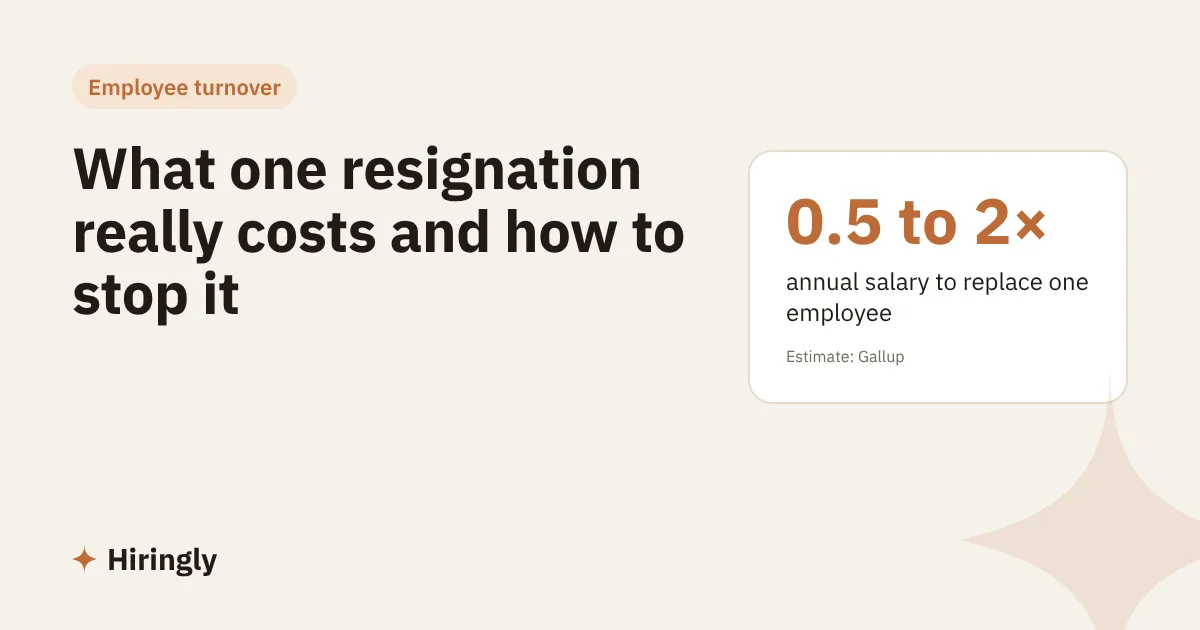
When a good person quits, you lose more than their output. You lose manager time, know-how and sometimes the colleagues who follow them out the door. Gallup estimates that replacing one employee costs between half and twice their annual salary. Here is how to measure turnover, understand it and bring it down.
Key points
- Gallup puts the cost of replacing an employee at 0.5 to 2 times their annual salary. At the average Czech wage, that is roughly CZK 312,000 to CZK 1.25 million.
- 52% of people who quit voluntarily say their departure could have been prevented.
- Almost 65% of Czech employers now rank keeping staff above hiring as their top priority.
- The biggest levers are career growth, good managers and hiring the right fit in the first place.
What employee turnover is and how to calculate it
Employee turnover tells you what share of your people left during a given period. The formula is simple:
Turnover rate = number of leavers in the period ÷ average headcount × 100
Example: a company with an average of 80 employees that lost 12 people over a year has an annual turnover rate of 15%.
Break it down by who leaves and why
One number is not enough. Track these separately:
- voluntary leavers (the employee resigns),
- involuntary leavers (dismissals, contracts ending),
- early leavers within 6 months of starting (a sign of poor selection or onboarding),
- regretted leavers (top performers, people with unique know-how).
Note: a low overall rate can hide a real problem. If your best people are the ones walking out, that hurts more than higher turnover among weaker performers.
What one resignation really costs
Gallup estimates that replacing an employee costs one-half to two times their annual salary, and calls this a conservative figure. The lower end fits simpler roles. The upper end fits specialists and managers.
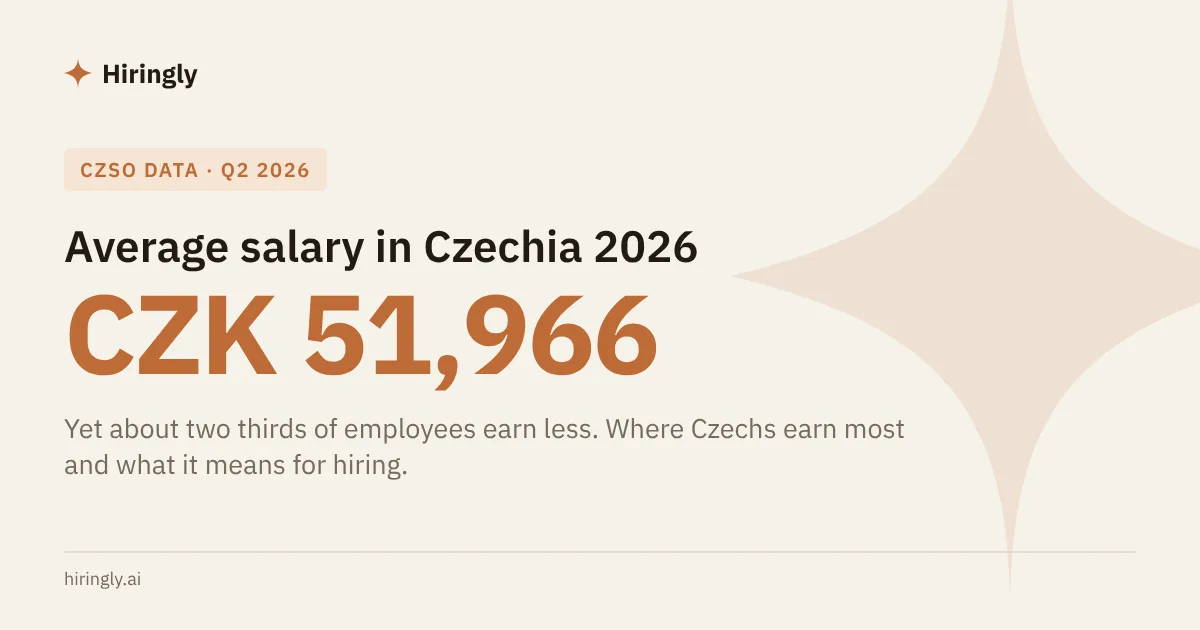
To make it concrete, we applied the estimate to Czech pay. According to the Czech Statistical Office, the average gross monthly wage in Q2 2026 was CZK 51,966.
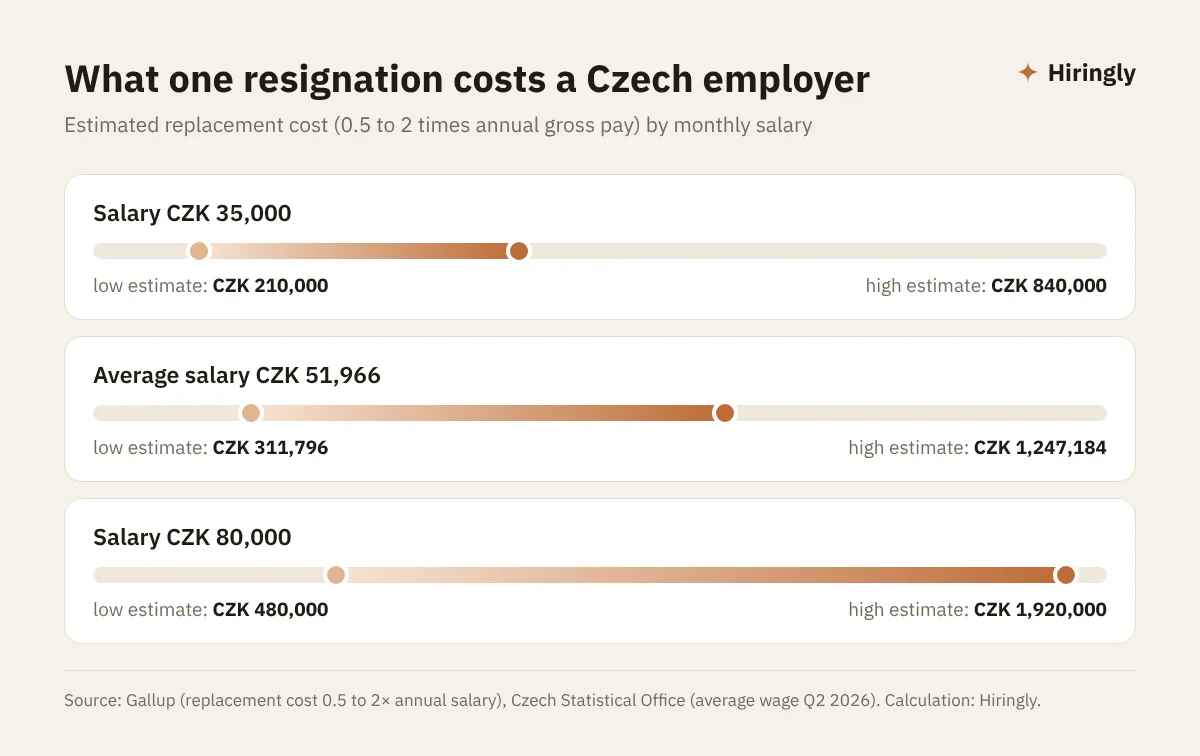
| Monthly gross salary | Annual salary | Estimated cost of a leaver |
|---|---|---|
| CZK 35,000 | CZK 420,000 | CZK 210,000 to 840,000 |
| CZK 51,966 (average) | CZK 623,592 | CZK 311,796 to 1,247,184 |
| CZK 80,000 | CZK 960,000 | CZK 480,000 to 1,920,000 |
Where the money goes
- Direct costs: job ads, HR and manager time spent interviewing, agency fees.
- Ramp-up: new hires usually need several months to reach full productivity.
- Lost output: the empty seat, colleagues working overtime, delayed projects.
- Hidden losses: know-how and client relationships walking out, lower team morale.
So a company of 80 people with 15% turnover at the average wage can lose CZK 3.7 to 15 million a year. That is reason enough to treat retention as a system, not an afterthought.
Why people in Czechia quit
The Czech job market still favours employees. According to Gallup, 66% of people in Czechia said in 2025 that it was a good time to find a job, up from just 15% in 2011. At the same time, Europe had the lowest engagement of any region: only 12% of employees were engaged, against 20% globally.
Employers feel it. In an Ipsos survey for Pluxee, reported by e15:
- more than 60% of employers said they struggle to fill positions,
- almost 65% said keeping existing staff is their biggest priority (fewer than 8% named hiring),
- almost 58% of employees said performance pressure had grown over the past year.
The most common reasons for leaving
- 1No career growth. In the Wellbeing Index 2025 by job portals JenPráce.cz and JenFirmy.cz, based on more than 10,000 employee reviews, career development scored only 2.97 out of 5 (Expats.cz).
- 2Pay. People leave when salary expectations go unmet.
- 3Managers and recognition. Poor leadership and lack of appreciation are among the main reasons people consider quitting, according to the same Pluxee survey.
- 4Overload. Rising pressure without real support for work-life balance.
The good news is that much of this is fixable. Gallup found that 52% of voluntary leavers say their manager or organisation could have done something to keep them. And 51% say nobody talked to them about their satisfaction or future in the three months before they left.
8 steps to reduce employee turnover
1. Measure it and split it by team
Calculate turnover for the past 12 months by team, role and manager. Problems tend to cluster: one team at 40% can distort the whole company picture.
2. Hire people who genuinely fit the role
Many departures start with the job ad. If you promise something the role does not deliver, people leave during probation. Write honest, specific ads (see our 9 rules for writing a job ad) and score every applicant against the same criteria.
AI helps when hundreds of CVs arrive. Hiringly, for example, is a free AI ATS that ranks applicants by how well they match your requirements and explains why for each one. Data stays in the EU, and a person always makes the call on who gets an interview.
3. Get the first 90 days right
Early leavers are the most expensive: you pay for hiring and training and get little back. Give every new hire a plan, a buddy and regular check-ins. Our 90-day onboarding checklist is a good starting point.
4. Show people a path inside the company
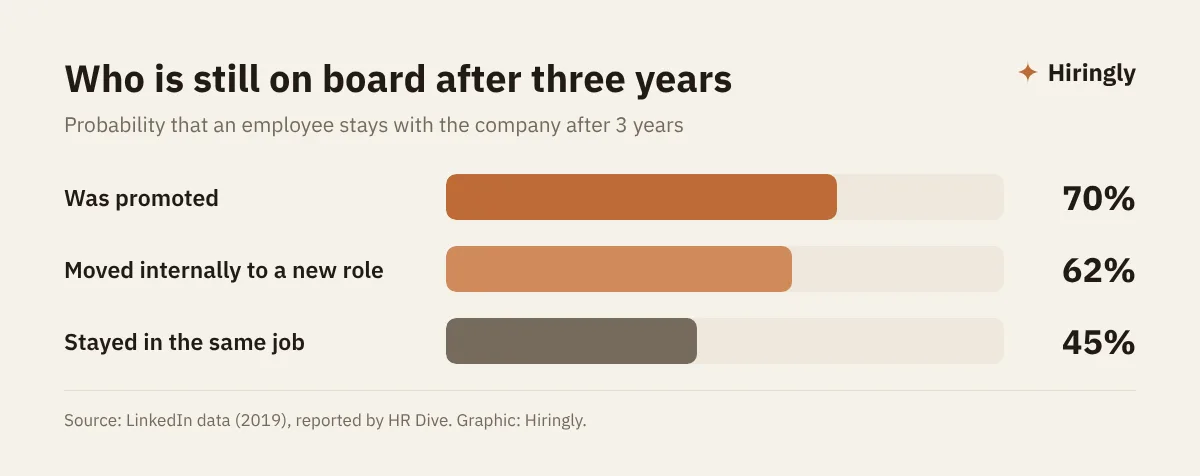
Career growth is the weakest spot for Czech employers, and the data shows why it matters. According to LinkedIn data reported by HR Dive, 70% of promoted employees and 62% of those who made a lateral move were still with the company after three years. For people who stayed in the same job, the figure was just 45%.
In practice: advertise openings internally first, and define a realistic next step for every role.
5. Train managers, not just employees
People leave bosses, not companies. Teach managers to run regular one-to-ones, give useful feedback and spot early signs of frustration.
6. Talk about satisfaction before the resignation letter
Run quarterly "stay interviews": a short conversation about what keeps someone, what bothers them and where they want to grow. It is cheaper than any exit interview.
7. Benchmark pay against the market
Once a year, compare your salaries with the market and with competitors' job ads. From 2027, Czech employers also face stricter pay transparency rules (covered in Pay transparency in Czechia), so pay gaps will be harder to hide.
8. Ask on the way out and use the answers
Exit interviews only matter if someone reads them. Collect answers in one place and review the top three reasons every quarter.
Retention checklist on one page
- I know our turnover rate for the past 12 months, by team.
- I know how many people left within 6 months of starting.
- Our job ads describe the role honestly, including pay.
- Every new hire has a 90-day plan and a buddy.
- Every role has a defined next career step.
- Managers hold regular one-to-ones and stay interviews.
- We have benchmarked pay against the market in the last year.
- We review exit interview results every quarter.
Curious what roles other Czech companies are hiring for right now? Browse the Hiringly public job board.
FAQ
What is a normal employee turnover rate?
There is no universal benchmark. It depends heavily on the sector: manufacturing, retail and services run much higher than office roles. What matters more is how your own rate changes over time and how many people leave within six months.
How do you calculate employee turnover?
Divide the number of leavers in a period by the average headcount for the same period and multiply by 100. The result is your turnover rate in percent.
How much does it cost to replace an employee?
Gallup estimates 0.5 to 2 times their annual salary. At the average Czech wage of CZK 51,966 a month, that is roughly CZK 312,000 to 1.25 million.
Will a pay rise alone stop people leaving?
Usually not. Pay matters, but Czech employees rate career development lowest, and many leave because of their manager or workload. A raise without fixing those tends to delay a resignation, not prevent it.
Can better hiring reduce turnover?
Yes. When a new hire's experience and expectations match the role, the risk of an early exit drops. Scoring every applicant against the same criteria helps a lot.
AI recommends, a human decides.
Hiringly shows the reasoning for every candidate, stores data in the EU and never rejects anyone automatically.