Guide
AI in Czech companies 2026: 35% use it. What it means for hiring
35% of Czech companies used AI in 2026, double last year. ČSÚ and Eurostat data, what it means for jobs, and a hiring checklist for the AI era.
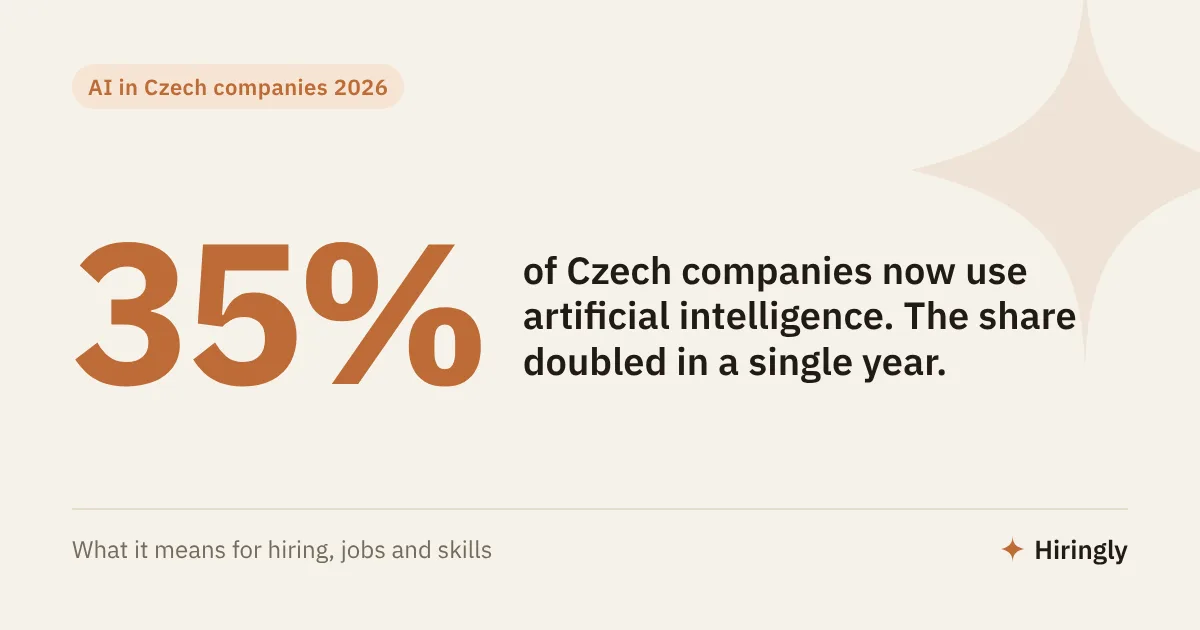
A year ago, artificial intelligence was still a side project for most Czech companies. In 2026, the Czech Statistical Office says 35% of firms with ten or more employees use it, double the share of the year before. So what does that mean for who companies hire, which skills they want and how hiring itself works?
Key points
- 35% of Czech companies with 10+ employees use AI in 2026, up from 18% in 2025, when Czechia sat just below the EU average of 20%.
- Large firms lead: almost three quarters of them use AI, against just under a third of small firms.
- The most common use is generating text, code or voice (31% of firms).
- Skills are shifting fast: the WEF expects almost 40% of the skills needed at work to change by 2030.
- For hiring, that means rewriting job ads, testing AI skills in interviews and investing more in training.
How many Czech companies use AI in 2026
The figures come from the Czech Statistical Office (ČSÚ) survey on ICT use in enterprises, published on 5 November 2026. Data were collected in the first half of the year.
- 35% of companies with 10 or more employees use AI (ČSÚ, 2026).
- The share doubled year on year. In 2025 it was 18% (ČSÚ, January 2026).
- 17% of firms pay for cloud based generative AI tools.
For context, 20.0% of EU enterprises used AI in 2025, up 6.5 percentage points from 2024 (Eurostat). Denmark (42.0%), Finland (37.8%) and Sweden (35.0%) led the ranking. Romania (5.2%) and Poland (8.4%) came last.
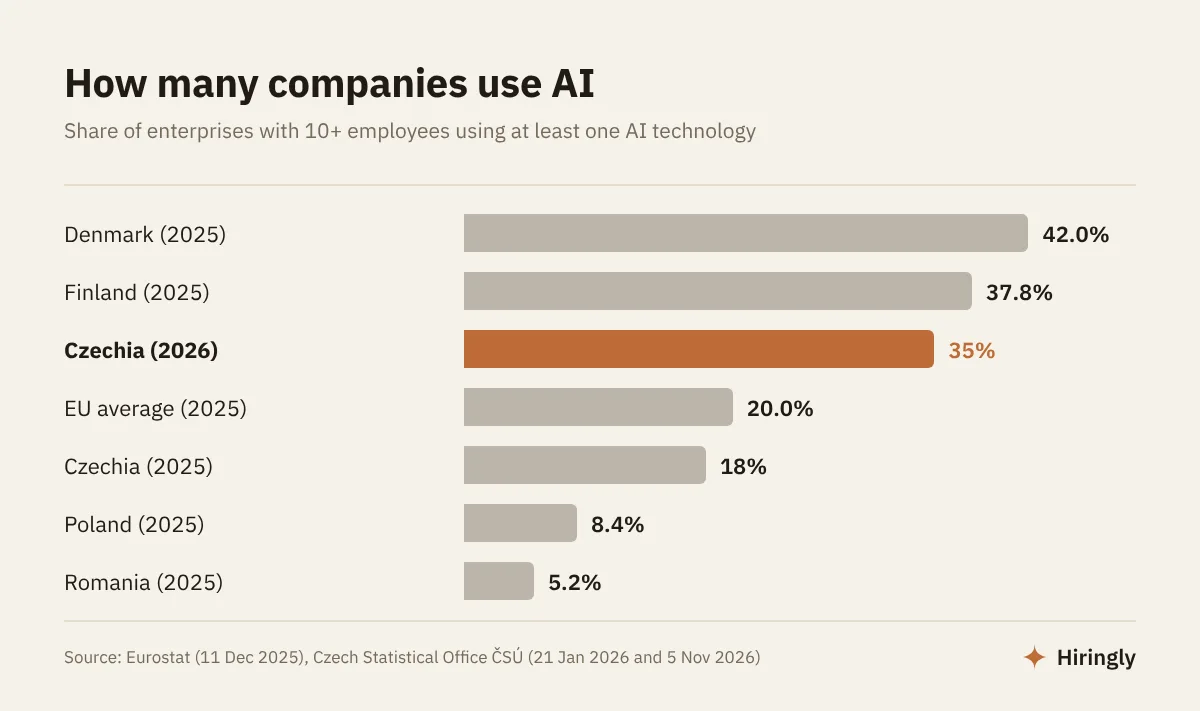
Note: the ČSÚ will publish the EU comparison for 2026 in January 2027. Until then, the 35% figure can only be set against EU data for 2025.
Big firms lead, small firms are catching up
Company size makes a big difference. This is how the ČSÚ describes it:
| Company size | Uses AI (2026) |
|---|---|
| Large (250+ employees) | almost three quarters |
| Medium (50 to 249) | half |
| Small (10 to 49) | just under a third |
| All firms with 10+ | 35% |
Source: ČSÚ, November 2026.
If you run a smaller business, take note. Candidates coming from large companies already work with AI tools every day, and they will expect the same from you.
What companies actually use AI for
Forget factory robots. In 2026, Czech AI is mostly an office tool.
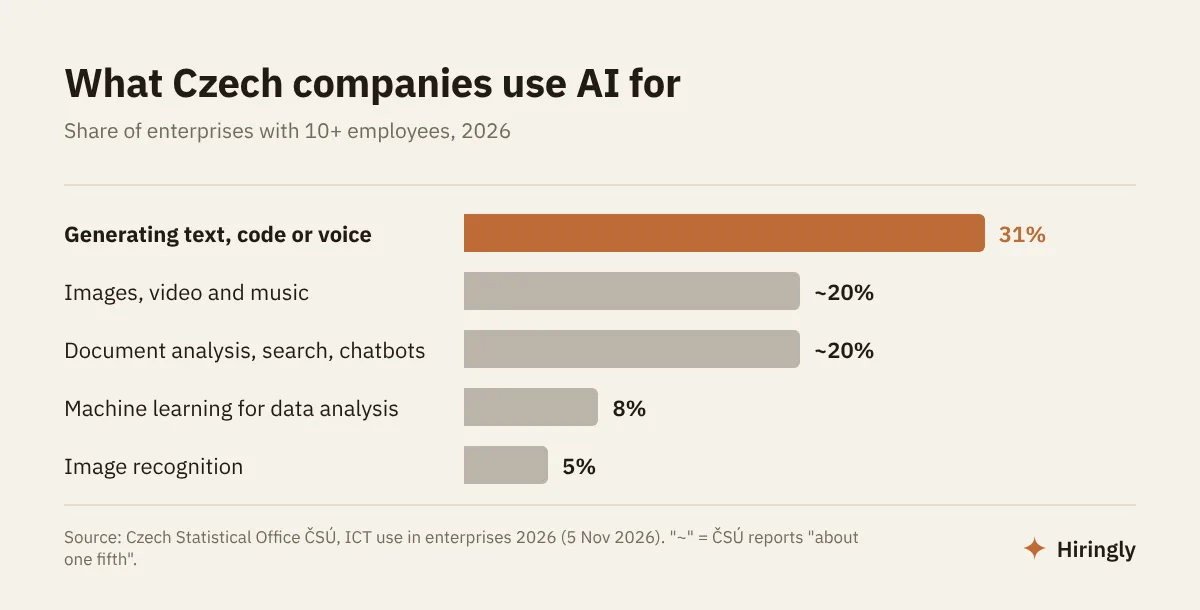
- 31% of firms generate text, program code or voice.
- About one fifth generate images, video or music.
- About one fifth use advanced text tools: document analysis, search and chatbots.
- 8% use machine learning for data analysis.
- 5% use image recognition (objects, people, documents).
People tell a similar story. In 2025, 32% of Czechs aged 16+ used AI tools, and one in five workers used them for work. Among 16 to 24 year olds the share was 78%, among university graduates 60% (ČSÚ, November 2025).
What it means for jobs
AI has not triggered mass layoffs in Czechia. What it is changing, quickly, is what people do all day.
The World Economic Forum's Future of Jobs Report 2025 expects that by 2030:
- 170 million jobs will be created and 92 million displaced, a net gain of 78 million,
- nearly 40% of the skills required on the job will change,
- 77% of employers plan to upskill their staff,
- 41% plan to cut headcount where AI automates tasks,
- 63% see the skills gap as the main barrier to change.
Cashiers and administrative assistants remain among the fastest declining roles, now joined by graphic designers. Roles in AI, data and cybersecurity are growing, and so are care, education and construction. We cover this in more depth in Jobs AI will replace.
Where Czech roles are changing most
Look at what companies use AI for and the pressure points are obvious:
- Admin and back office: transcripts, meeting notes, document drafting.
- Marketing and content: copy, visuals, translation.
- Customer support: chatbots and suggested replies.
- Software development: writing and reviewing code.
- HR and recruiting: job ads, first CV screening, candidate communication.
These jobs are not disappearing. But one person with AI now covers more ground, so companies are hiring for a different profile than two years ago.
How AI is changing hiring: 5 shifts for HR and business owners
1. Put real AI work in the job ad
If your team uses AI, say how. Skip "AI knowledge is a plus" and write "you will use ChatGPT or Copilot daily to prepare client proposals". For more on writing ads that pull in the right people, see How to write a job ad.
2. Test the skill, not the claim
Almost everyone now lists "AI" on their CV. Give candidates a short practical task in the interview: summarise a document, draft a client email, or spot the mistake in an AI generated answer. Critical thinking matters more than knowing a specific tool.
3. More applicants, more AI written CVs
Candidates use AI for CVs and cover letters too. Employers get more applications, and many look alike. Screening hundreds of CVs by hand is slow and unfair to whoever applied last.
This is where AI helps the employer. Hiringly, for example, is a free AI ATS: it ranks applicants by fit for the role and explains why for each one. Data stays in the EU, and a human always makes the interview decision.
4. Train people instead of hunting for unicorns
People who know both their field and AI are rare. It is often faster to hire someone sharp and eager to learn, then train them. According to the WEF, 77% of employers plan to do exactly that. We list the skills worth most in Future skills 2030.
5. The rules: AI Act and GDPR
Under the EU AI Act, AI used to select employees counts as high risk. Employers must inform candidates and keep a human in the loop. Deadlines and duties are in EU AI Act in recruiting.
Checklist: is your company ready to hire in the AI era?
Go through these 8 points. Every "no" is a place where you may be losing good candidates or time.
- 1We know which AI tools our people use and what for.
- 2Our job ads describe specifically how we work with AI.
- 3Our interviews include a practical task that tests AI use and critical thinking.
- 4We assess CVs against requirements written down in advance, not gut feeling.
- 5We tell candidates whether and how we use AI in selection.
- 6A human always decides who moves to the next round.
- 7We have a plan to train new hires on our AI tools within 90 days.
- 8We store candidate data in the EU and delete it in line with GDPR.
Looking for a job yourself? Browse current openings on the Hiringly job board.
FAQ
How many Czech companies use artificial intelligence?
In 2026, 35% of Czech companies with 10 or more employees use AI, double the 18% recorded a year earlier. The figure comes from the ČSÚ survey published on 5 November 2026.
Is Czechia behind the EU on AI adoption?
In 2025, Czechia's 18% was slightly below the EU average of 20%. For generative AI used for text or code, it was ahead (13% against 9%). The ČSÚ will publish the 2026 EU comparison in January 2027.
Which jobs in Czechia are most exposed to AI?
Admin and office roles, customer support and content creation are changing most. The WEF lists cashiers, administrative assistants and graphic designers among the fastest declining roles. In most cases the job changes rather than disappears.
Can employers use AI to select candidates?
Yes, with conditions. The AI Act classifies AI in recruiting as high risk, so employers need human oversight, transparency towards candidates and GDPR compliance. A person should always make the final decision.
How can I check whether a candidate can really work with AI?
Set a short practical task in the interview, such as summarising a document or correcting a flawed AI answer. Watch how the candidate writes the prompt and whether they check the result critically.
AI recommends, a human decides.
Hiringly shows the reasoning for every candidate, stores data in the EU and never rejects anyone automatically.